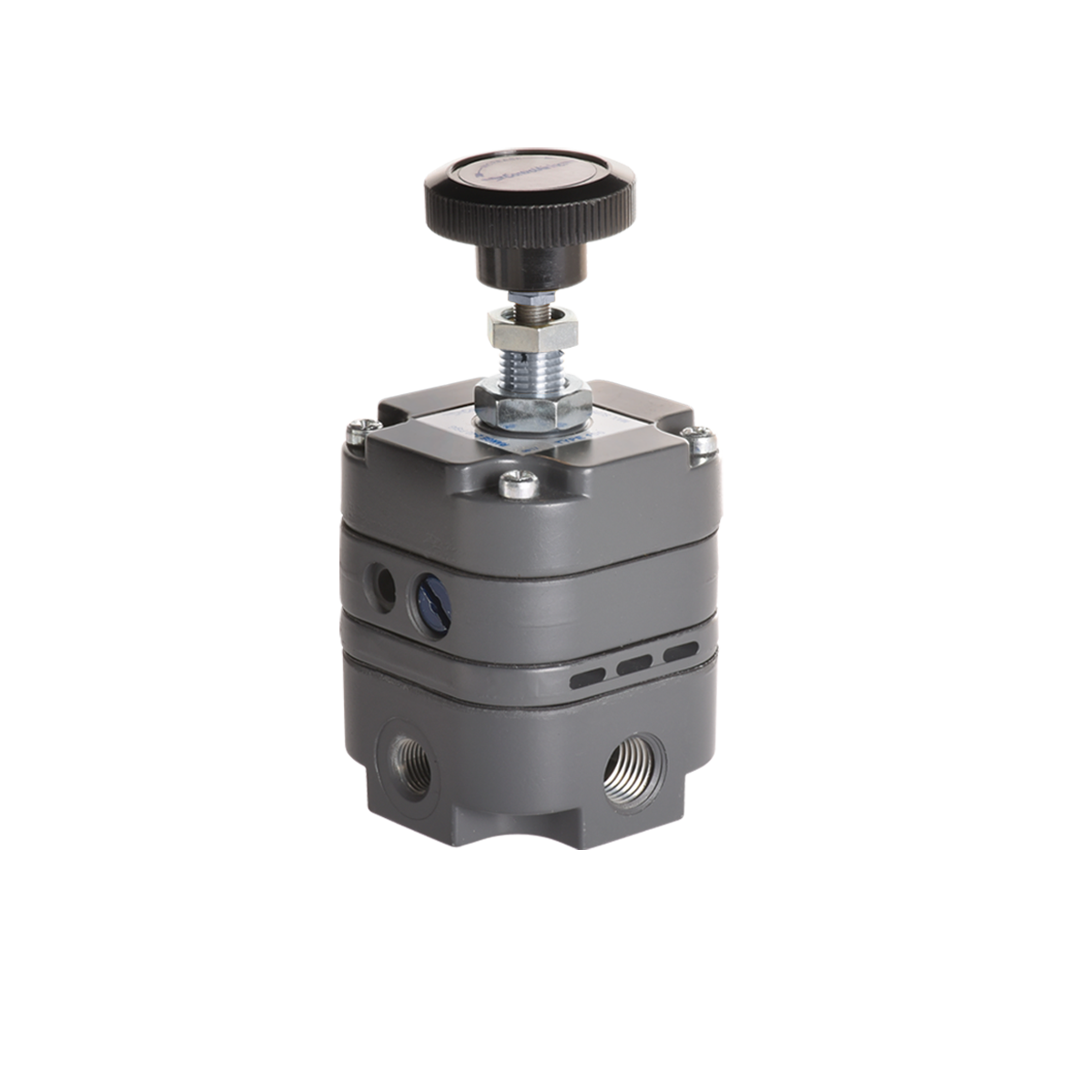
The Type 100 Precision Air Pressure Regulator delivers the highest level of regulation accuracy, repeatability, and stability available in the ControlAir precision regulator portfolio. Designed for demanding applications requiring exceptionally stable output pressure under changing operating conditions, the Type 100 utilizes a multi-stage, servo-balanced control system with a stainless steel measuring capsule to achieve regulation accuracy up to 0.1%.
Unlike conventional regulators that rely on range springs and diaphragms, the Type 100 uses a pilot-operated design that continuously compensates for fluctuations in supply pressure and downstream demand. The result is highly accurate pressure control, minimal droop, outstanding sensitivity, and exceptional repeatability for calibration, testing, measurement, and precision automation applications.
Key Features
Pressure regulation accuracy up to 0.1%
High repeatability and long-term stability
Low droop under changing flow conditions
High sensitivity for precise low-pressure control
Servo-balanced, multi-stage pressure control design
Stainless steel measuring capsule sensing element
Stable output pressure under varying supply conditions
Available in multiple pressure ranges and port sizes
High-relief and extra-high-relief configurations available
Low-range model for ultra-precise low-pressure applications
Optional plunger, motorized, and manifold-mount configurations
Suitable for laboratory, OEM, industrial, and automation systems
Performance Characteristics
Specification
Value
Regulation Accuracy
Up to 0.1%
Flow Capacity
14 scfm (420 NL/min)
Exhaust Capacity
Up to 15 scfm (425–450 NL/min)
Sensitivity
1/8 in. water column (3.2 mm)
Supply Pressure Sensitivity
Less than 0.005 psig for a 25 psig supply pressure change
Maximum Supply Pressure
150 psig (10 bar)
Air Consumption
6 scfh (3 NL/min)
Temperature Range
-20°F to 160°F (-29°C to 71°C)
Weight
1.4 lb (635 g)
These performance characteristics enable highly stable pressure control, rapid response to system changes, and exceptional repeatability in precision pneumatic applications. The servo-balanced pilot control mechanism minimizes the influence of inlet pressure variations while maintaining consistent output pressure under dynamic conditions.
How to Select the Right Configuration
Selecting the correct Type 100 configuration depends on your application requirements:
Choose the Appropriate Pressure Range
Low Range (100LR): 0.5–25 psig
Standard Range: 2–40 psig
Standard Range: 2–60 psig
Standard Range: 2–120 psig
Match Flow and Exhaust Requirements
Standard models provide excellent regulation performance for most applications.
High Relief (100HR) and Extra High Relief (100EHR) models provide faster exhaust performance for dynamic systems and counterbalance applications.
The Type 100 is designed for applications where pressure stability, repeatability, and accuracy are critical:
Calibration equipment
Leak testing systems
Air gauging
Coordinate Measuring Machines (CMM)
Semiconductor manufacturing
Medical and diagnostic equipment
Laboratory instrumentation
Process control systems
Pneumatic counterbalance systems
High-precision automation equipment
Research and development testing systems
The combination of ultra-stable pressure regulation and high sensitivity makes the Type 100 particularly well suited for applications where even small pressure variations can affect performance or measurement accuracy.
The Type 100 uses a stainless steel measuring capsule and servo-balanced pilot-operated control mechanism to achieve regulation accuracy up to 0.1%, exceptional repeatability, and stable output pressure under changing operating conditions.
What is droop and why does it matter?
Droop is the decrease in outlet pressure as flow demand increases. The Type 100 minimizes droop, helping maintain accurate pressure control even when downstream demand changes.
When should I choose the low-range model?
The Type 100LR is ideal for applications requiring highly accurate control below 25 psig, such as calibration equipment, air gauging, and laboratory instrumentation.
What is the benefit of high-relief and extra-high-relief models?
These configurations provide faster exhaust capability, allowing output pressure to decrease more rapidly when system demand changes. They are commonly used in counterbalance systems and applications requiring rapid pressure decay.
How does the Type 100 maintain pressure stability?
A pilot valve continuously controls the main valve through a high-gain servo-balanced mechanism. This design compensates for inlet pressure fluctuations and changing flow demand, resulting in highly stable outlet pressure.
Get news, updates, and offers direct to your inbox.
We use cookies on our website to give you the most relevant experience by remembering your preferences and repeat visits. By clicking “Accept”, you consent to the use of ALL the cookies.
This website uses cookies to improve your experience while you navigate through the website. Out of these cookies, the cookies that are categorized as necessary are stored on your browser as they are essential for the working of basic functionalities of the website. We also use third-party cookies that help us analyze and understand how you use this website. These cookies will be stored in your browser only with your consent. You also have the option to opt-out of these cookies. But opting out of some of these cookies may have an effect on your browsing experience.
Necessary cookies are absolutely essential for the website to function properly. These cookies ensure basic functionalities and security features of the website, anonymously.
Cookie
Duration
Description
cookielawinfo-checkbox-analytics
11 months
This cookie is set by GDPR Cookie Consent plugin. The cookie is used to store the user consent for the cookies in the category "Analytics".
cookielawinfo-checkbox-functional
11 months
The cookie is set by GDPR cookie consent to record the user consent for the cookies in the category "Functional".
cookielawinfo-checkbox-necessary
11 months
This cookie is set by GDPR Cookie Consent plugin. The cookies is used to store the user consent for the cookies in the category "Necessary".
cookielawinfo-checkbox-others
11 months
This cookie is set by GDPR Cookie Consent plugin. The cookie is used to store the user consent for the cookies in the category "Other.
cookielawinfo-checkbox-performance
11 months
This cookie is set by GDPR Cookie Consent plugin. The cookie is used to store the user consent for the cookies in the category "Performance".
viewed_cookie_policy
11 months
The cookie is set by the GDPR Cookie Consent plugin and is used to store whether or not user has consented to the use of cookies. It does not store any personal data.
Functional cookies help to perform certain functionalities like sharing the content of the website on social media platforms, collect feedbacks, and other third-party features.
Performance cookies are used to understand and analyze the key performance indexes of the website which helps in delivering a better user experience for the visitors.
Analytical cookies are used to understand how visitors interact with the website. These cookies help provide information on metrics the number of visitors, bounce rate, traffic source, etc.
Advertisement cookies are used to provide visitors with relevant ads and marketing campaigns. These cookies track visitors across websites and collect information to provide customized ads.