Sign up for the ControlAir newsletter.
Get news, updates, and offers direct to your inbox.
Basic Vacuum Application Concerns: Small Issues that Create Big Problems
Vacuum systems often look simple on paper, but in practice, they can be surprisingly unforgiving. Small oversights—tiny leaks, overlooked materials, or poor component placement—can lead to unstable performance, excessive energy consumption, or outright system failure. Understanding the most common vacuum application concerns early in the design process can save significant time, cost, and frustration later on.
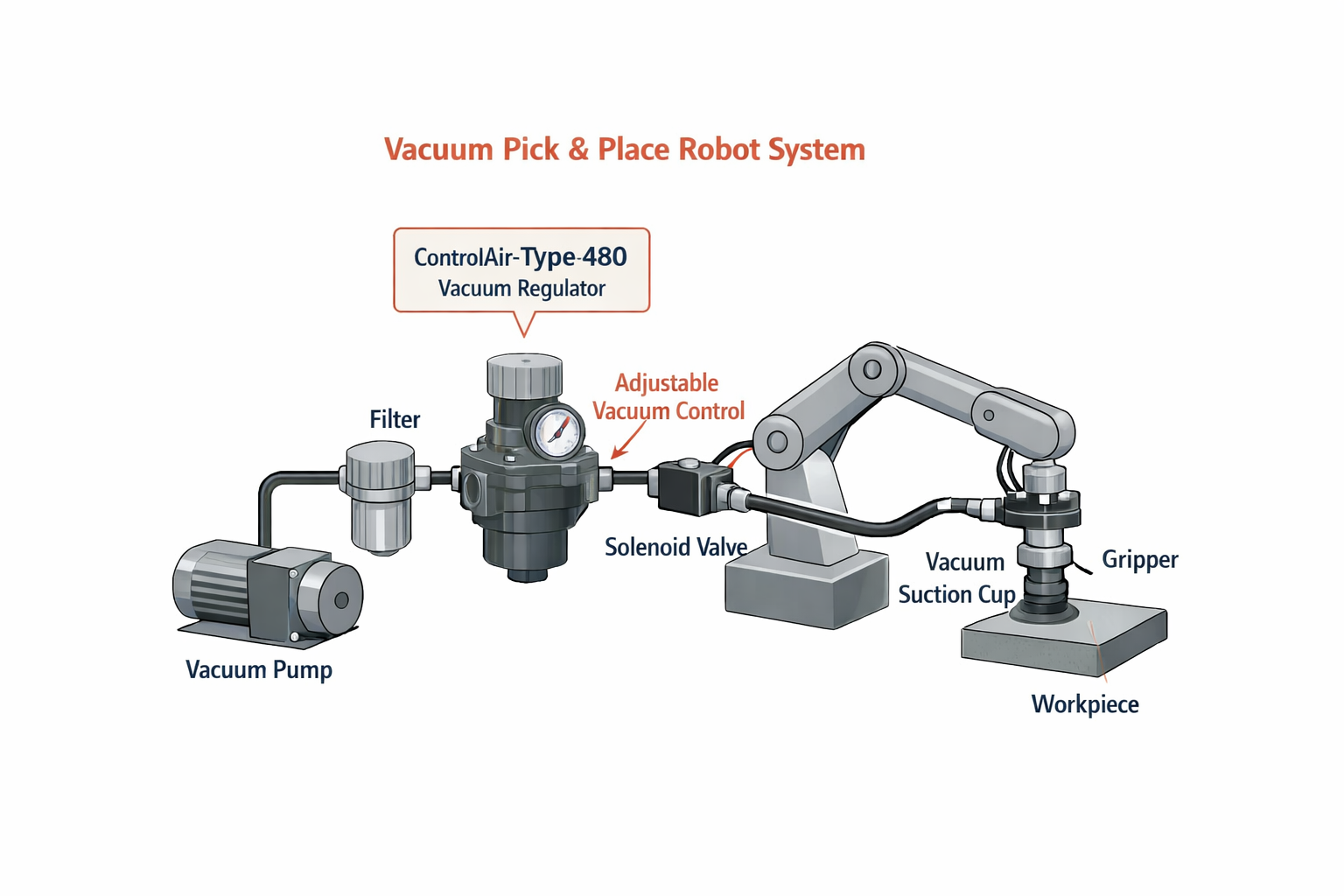
One of the most common mistakes in vacuum applications is underestimating the effect of minor leaks. Unlike pressure systems, where a small leak may only result in a gradual loss, vacuum systems are constantly fighting atmospheric pressure. Even a pinhole leak, a poorly sealed fitting, or a slightly permeable hose can dramatically reduce achievable vacuum levels.
Leaks force the vacuum source to work harder and longer to maintain setpoints, often resulting in:
Common leak sources include threaded fittings, quick-connect couplings, worn seals, tubing connections, and even porous materials used in fixtures or tooling.
Not all materials behave the same under vacuum. Some elastomers and plastics that work well in pressure applications can permeate air when used in vacuum service. Over time, this permeation can mimic a leak even when all fittings are technically sealed.
Additionally, materials may outgas—releasing trapped gases when exposed to vacuum—which can slow pump-down times and prevent the system from reaching its target vacuum level. This is especially important in applications requiring stable or repeatable vacuum conditions.
For vacuum applications, Fluoroelastomers (FKM/Viton) are top choices due to low gas permeability and high temp resistance, with Perfluoroelastomers (FFKM/Kalrez) offering even better performance for Ultra-High Vacuum (UHV), while Buna-N (Nitrile), EPDM, and high-purity Silicone are suitable for less demanding rough vacuum or specific conditions, always considering outgassing and chemical compatibility.
Vacuum lines that are too small, too long, or routed inefficiently can severely restrict flow. While pressure drop calculations are common in pressure systems, similar attention is often missing in vacuum designs.
Excessive restrictions can cause:
Sharp bends, undersized tubing, unnecessary fittings, and restrictive valves all contribute to flow losses that degrade system performance.
Where components are located in a vacuum system matters. Sensors, regulators, and valves placed too far from the point of use may see delayed or inaccurate readings due to line volume and flow restrictions.
This can result in:
Placing control components as close as practical to the load often improves system stability and repeatability.
Vacuum systems frequently pull in more than just air. Dust, process debris, oil mist, and moisture can all enter the system if not properly filtered or trapped. Over time, contamination can clog or damage regulators, valves, and pumps, leading to drifting performance or premature failure.
In applications involving ambient air or harsh environments, filtration and separation should be considered a core design requirement—not an afterthought.
Another common issue is assuming that “more vacuum” is always better. Oversized pumps can increase cost, noise, and energy consumption without improving performance. In some cases, excessive vacuum can even damage products, deform materials, or create unnecessary safety concerns.
A well-designed system produces only as much vacuum as the application truly requires, delivered consistently and efficiently.
Final Thought
Vacuum systems are highly sensitive by nature. Small leaks, minor restrictions, and subtle material choices can have a much larger impact than expected. Taking a holistic view—considering sealing, materials, flow, component placement, and contamination—early in the design process leads to more stable, efficient, and reliable vacuum applications.