

Description
Overview
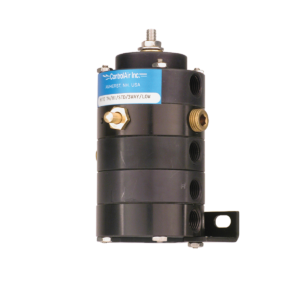
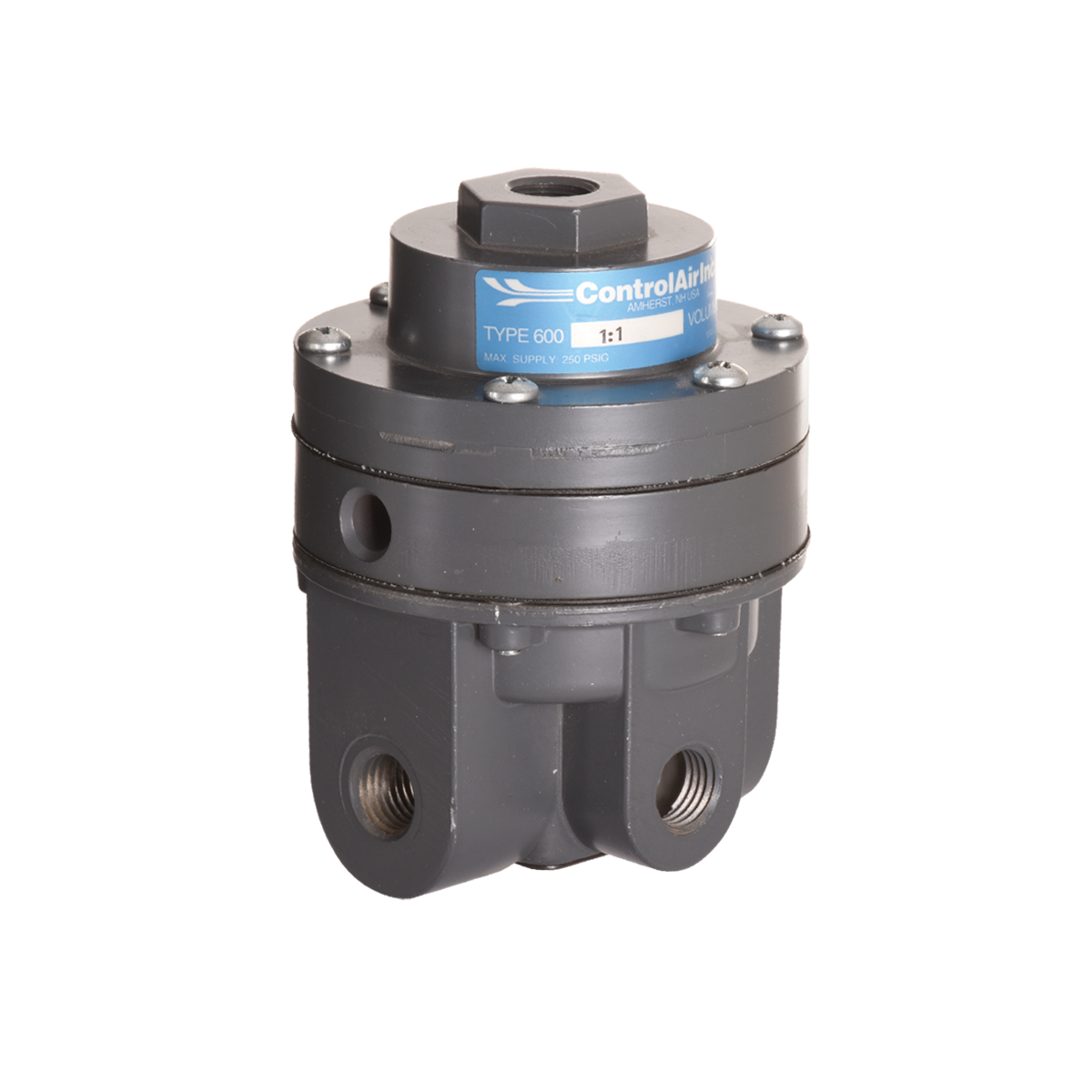
The Type 600 Ratio Relay Volume Booster is designed to convert a low-flow pneumatic control signal into a higher-flow output for operating pneumatic equipment. Using an independent supply pressure to provide greater air volume, the Type 600 can deliver flow capacity up to 50 SCFM (1,415 Nl/min) to final control elements such as valve actuators.
The standard Type 600 provides a 1:1 signal-to-output ratio, with additional amplified ratios of 1:2, 1:3, and 1:6 and reducing ratios of 2:1 and 3:1 available. This range of ratios allows the booster to increase flow capacity while also adapting output pressure to the requirements of the pneumatic system.
A Venturi aspirator helps maintain stable output pressure under varying flow conditions, while a balanced supply valve with a rolling diaphragm design minimizes the effect of supply pressure variation. With multiple port sizes, optional negative bias, and flexible mounting configurations, the Type 600 is suited for flow boosting, pressure amplification, and remote pressure control applications.
Key Features
- Ratio relay pneumatic volume booster
- Converts a low-flow pneumatic signal to a high-flow output
- Flow capacity up to 50 SCFM (1,415 Nl/min)
- Standard 1:1 signal-to-output ratio
- Amplified 1:2, 1:3, and 1:6 ratios available
- Reducing 2:1 and 3:1 ratios available
- Venturi aspirator helps maintain stable output pressure under varying flow conditions
- Balanced supply valve minimizes the effect of supply pressure variation
- Rolling diaphragm design
- 1/4″, 3/8″, and 1/2″ port sizes
- NPT and BSPP porting available
- Optional -4 ±1 psi negative bias
- Optional tapped exhaust for captured exhaust applications
- Pipe, panel, or bracket mounting
- ATEX 2014/34/EU option available
Performance Characteristics
- Available Signal-to-Output Ratios: 1:1, 1:2, 1:3, 1:6, 2:1, and 3:1
- Maximum Supply Pressure: 250 psig (17.5 bar)
- Maximum Signal Pressure, 1:1 Ratio: 150 psig (10.3 bar)
- Maximum Signal Pressure, 1:2 Ratio: 75 psig (5.2 bar)
- Maximum Signal Pressure, 1:3 Ratio: 50 psig (3.4 bar)
- Maximum Signal Pressure, 1:6 Ratio: 25 psig (1.7 bar)
- Maximum Signal Pressure, 2:1 Ratio: 150 psig (10.3 bar)
- Maximum Signal Pressure, 3:1 Ratio: 150 psig (10.3 bar)
- Flow Capacity: 50 SCFM (1,415 Nl/min)
- Maximum Flow Coefficient (Cv): 1.0
- Exhaust Capacity, 1:1 Ratio: 15 SCFM (425 Nl/min)
- Exhaust Capacity, 1:2 Ratio: 15 SCFM (425 Nl/min)
- Exhaust Capacity, 1:3 Ratio: 15 SCFM (425 Nl/min)
- Exhaust Capacity, 1:6 Ratio: 10 SCFM (283 Nl/min)
- Sensitivity, 1:1 Ratio: 0.25 inches water (0.64 cm)
- Sensitivity, 1:2 Ratio: 0.50 inches water (1.3 cm)
- Sensitivity, 1:3 Ratio: 0.75 inches water (1.9 cm)
- Sensitivity, 1:6 Ratio: 1.50 inches water (3.8 cm)
- Ratio Accuracy, 1:1 Ratio: 1.0% of output span with 3-15 psig signal
- Ratio Accuracy, 1:2 Ratio: 1.12% of output span with 3-15 psig signal
- Ratio Accuracy, 1:3 Ratio: 1.25% of output span with 3-15 psig signal
- Ratio Accuracy, 1:6 Ratio: 2.0% of output span with 3-15 psig signal
- Supply Pressure Effect, 1:1 Ratio: 0.1 psi for a 50 psig supply pressure change
- Supply Pressure Effect, 1:2 Ratio: 0.2 psi for a 50 psig supply pressure change
- Supply Pressure Effect, 1:3 Ratio: 0.3 psi for a 50 psig supply pressure change
- Supply Pressure Effect, 1:6 Ratio: 0.6 psi for a 50 psig supply pressure change
- Maximum Steady-State Air Consumption: 1.0 to 10.0 SCFH (0.5 to 5 Nl/min), depending on output pressure range
- Ambient Temperature Range: -40°F to 160°F (-40°C to 71°C)
- Port Sizes: 1/4″, 3/8″, or 1/2″ NPT/BSPP
- Mounting: Pipe, panel, or bracket
- Weight: 1.4 lbs (635 g)
The Type 600 provides up to 50 SCFM of flow with a maximum Cv of 1.0. Performance varies with the selected signal-to-output ratio, including maximum signal pressure, sensitivity, ratio accuracy, and supply pressure effect.
How to Select the Right Configuration
Selecting the correct Type 600 configuration depends on the required signal-to-output ratio, connection size, output pressure requirements, exhaust configuration, and pneumatic control application.
- Select the 1:1 ratio when the output pressure should follow the pneumatic signal pressure while providing increased flow capacity
- Select the 1:2, 1:3, or 1:6 ratio when the output pressure must be amplified relative to the input signal
- Select the 2:1 or 3:1 ratio when a reducing signal-to-output relationship is required
- Select 1/4″, 3/8″, or 1/2″ porting based on the required piping connection
- Select BSPP Porting when BSPP connections are required
- Select the Negative Bias option when a -4 ±1 psi bias is required to help zero an I/P transducer
- Select the Tapped Exhaust option when captured exhaust is required
- Select the ATEX option when ATEX 2014/34/EU compliance is required
- Choose pipe, panel, or bracket mounting based on the installation requirements
Because maximum signal pressure and performance characteristics vary by ratio, the selected ratio should be matched to the required input signal and desired output pressure.
For additional guidance:
Applications
The Type 600 is designed for pneumatic systems requiring increased flow capacity, pressure amplification, or remote pressure control. The specification sheet identifies applications ranging from process valve actuation to industrial web and motion control.
- Web tensioning
- Roll loading
- Control valve actuators
- I/P volume boosting
- Cylinder actuation
- Clutch control
- Brake control
- Gas flow control
- Pressure amplification
- Remote pressure control
- High-flow pneumatic control systems
Principle of Operation
When pneumatic pressure is introduced through the Type 600 signal port, it creates a downward force on the upper signal diaphragm. Output pressure acts against the lower control diaphragm, creating an opposing force. The relationship between signal pressure and output pressure is determined by the ratio of the effective areas of these two diaphragms.
When signal pressure increases above the required output pressure, the diaphragm assembly moves downward and opens the supply valve. Air from the independent supply flows to the output until equilibrium is reached. When signal pressure decreases below the output pressure, the diaphragm assembly moves upward and allows downstream air to exhaust through the relay vent.
The principle-of-operation diagram on page 2 shows the signal diaphragm, relief valve, control diaphragm, supply valve, balance diaphragm, aspirator tube, and the supply, signal, output, and atmospheric pressure paths through the Type 600.
Models & Configurations
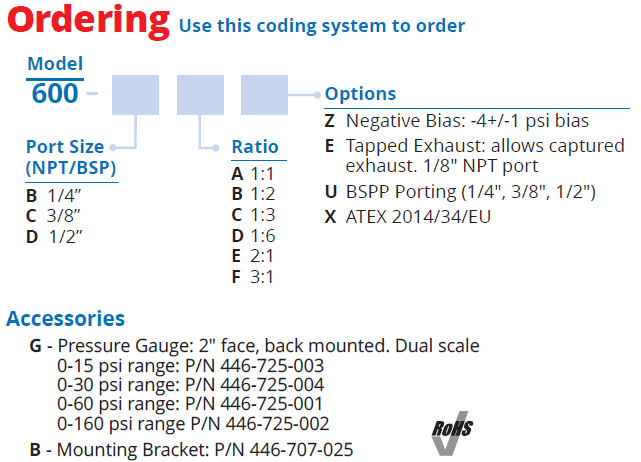
Type 600 Ordering Structure
600-[Port Size][Ratio][Options]
Port Size
- B = 1/4″
- C = 3/8″
- D = 1/2″
Signal-to-Output Ratio
- A = 1:1
- B = 1:2
- C = 1:3
- D = 1:6
- E = 2:1
- F = 3:1
Available Options
- Z = Negative Bias, -4 ±1 psi
- E = Tapped Exhaust, 1/8″ NPT port for captured exhaust
- U = BSPP Porting, available in 1/4″, 3/8″, and 1/2″
- X = ATEX 2014/34/EU
The Type 600 ordering system combines the selected port size, signal-to-output ratio, and optional features into the model number.
Accessories
- 0-15 psi Dual Scale Pressure Gauge: P/N 446-725-003
- 0-30 psi Dual Scale Pressure Gauge: P/N 446-725-004
- 0-60 psi Dual Scale Pressure Gauge: P/N 446-725-001
- 0-160 psi Dual Scale Pressure Gauge: P/N 446-725-002
- Mounting Bracket: P/N 446-707-025
Materials of Construction
- Body: Die-Cast Aluminum
- Internal Components: Stainless Steel, Brass, Plated Steel, and Acetal
- Diaphragm: Nitrile Elastomer and Polyester Fabric
The combination of a die-cast aluminum body and metal internal components provides a compact construction for industrial pneumatic applications, while the diaphragm assembly uses nitrile elastomer reinforced with polyester fabric.
Technical Resources
- Product Data Sheet
- Installation Information
- CAD Models
- Product Certifications
- Engineering Support Resources
FAQs
What is the Type 600 ratio relay volume booster used for?
The Type 600 converts a low-flow pneumatic control signal into a higher-flow output. It is used for increased flow capacity, pressure amplification, and remote pressure control in applications such as valve actuation, web tensioning, cylinder actuation, and I/P volume boosting.
What is the flow capacity of the Type 600?
The Type 600 provides flow capacity up to 50 SCFM (1,415 Nl/min) with a maximum flow coefficient of Cv 1.0.
What signal-to-output ratios are available?
The Type 600 is available with 1:1, 1:2, 1:3, 1:6, 2:1, and 3:1 signal-to-output ratios.
Can the Type 600 amplify pneumatic pressure?
Yes. The 1:2, 1:3, and 1:6 configurations provide amplified signal-to-output ratios for applications requiring output pressure greater than the pneumatic input signal.
What is the maximum supply pressure?
The maximum supply pressure of the Type 600 is 250 psig (17.5 bar).
What port sizes are available?
The Type 600 is available with 1/4″, 3/8″, and 1/2″ ports. NPT and optional BSPP connections are available.
How does the Type 600 maintain stable output pressure?
A Venturi aspirator helps maintain output pressure under varying flow conditions, while the balanced supply valve design reduces the effect of supply pressure variations.
What is the negative bias option used for?
The optional negative bias provides a -4 ±1 psi bias and can be used to help zero I/P transducers.
Can the Type 600 provide captured exhaust?
Yes. The optional tapped exhaust provides a 1/8″ NPT port that allows the exhaust air to be captured.
What is the operating temperature range?
The Type 600 has an ambient operating temperature range of -40°F to 160°F (-40°C to 71°C).
How can the Type 600 be mounted?
The Type 600 can be pipe mounted, panel mounted, or installed using an optional mounting bracket.
Is an ATEX option available?
Yes. An ATEX 2014/34/EU option is available for the Type 600.