Skip to content
Logo
×
Find a Distributor Request a Quote
  • Products
    • Pressure Regulators
    • Back Pressure Regulators
    • Filter Regulators
    • Gas Regulators
    • Precision Pressure Regulators
    • Pressure Regulators
    • Stainless Steel Pressure Regulators
    • Potable Water Pressure Regulators
    • Brackets, Gauges, & Accessories
    • Electronic Pressure Regulators
    • Pressure Transducers
    • I/P Transducers (current-to-pressure)
    • E/P Transducers (voltage-to-pressure)
    • P/I Transducers (pressure-to-current)
    • I/PAC Integrated Process Air Control
    • Supply Manifold
    • Brackets, Gauges, & Accessories
    • Diaphragm Air Cylinders
    • Rolling Diaphragm Cylinder
    • Small Bore Compact Cylinder
    • Mini Might Cylinders
    • Pneumatic Air Filters
    • Air Relays
    • Vacuum Regulators
    • Valve Positioners
    • Volume Boosters
    • Stainless Steel Volume Boosters
    • No-Brass Products
    • View All Products
  • Custom Solutions
  • Industries
    • Food and Beverage Processing Markets
    • Control Valve Products
    • Oil & Gas Markets
    • Waste Water Processing and Treatment
    • View All Industries
  • Engineers
  • Resources
    • Blog
    • CAD Models & Product Specifier
    • Certifications
    • Catalogs
    • FAQ
    • How to Determine the Appropriate Regulator
    • Instruction Manuals
    • Product Selection Guides
    • Visual Product Reference Guides
    • Videos
    • Volume Booster Sizing Guide
    • White Papers
  • Contact
    • Request a Quote
    • Ask an Expert
    • Contact
    • Request Help From Our Sales Team
  • About
    • About Us
    • News
    • Who We Help
    • Career Opportunities
  • Find a Distributor
  • Request a Quote
(603) 886-9400 | Distributor Login

Choosing the Correct Regulator: Part II – Gas Compatibility

Gas regulator selection requires checking that every material exposed to the gas is compatible with the application. The regulator body, diaphragm, valve seat, seals, and internal components must suit the gas composition, operating pressure, and temperature. Exhaust behavior and the surrounding environment also affect the choice.

This is Part II of ControlAir’s “Choosing the Correct Regulator” series. After establishing your pressure requirements, the next question is: What gas will the regulator control?

Why Does Gas Compatibility Matter?

A regulator intended for compressed air should not automatically be used with oxygen, natural gas, or another process gas. Materials that perform well in one application may deteriorate or behave differently in another.

Start with the complete gas composition, including any moisture, contaminants, or additives. A description such as “natural gas” may not provide enough information to select the correct materials and configuration.

Which Regulator Parts Contact the Gas?

Wetted parts are the components exposed to the controlled gas during operation. Depending on the regulator design, these can include:

  • The body and internal passages.
  • The diaphragm or other pressure-sensing element.
  • The valve seat, supply valve, and internal trim.
  • O-rings, gaskets, and other seals.

Review the complete wetted-material list. Selecting a compatible body material alone does not establish compatibility for the assembled regulator.
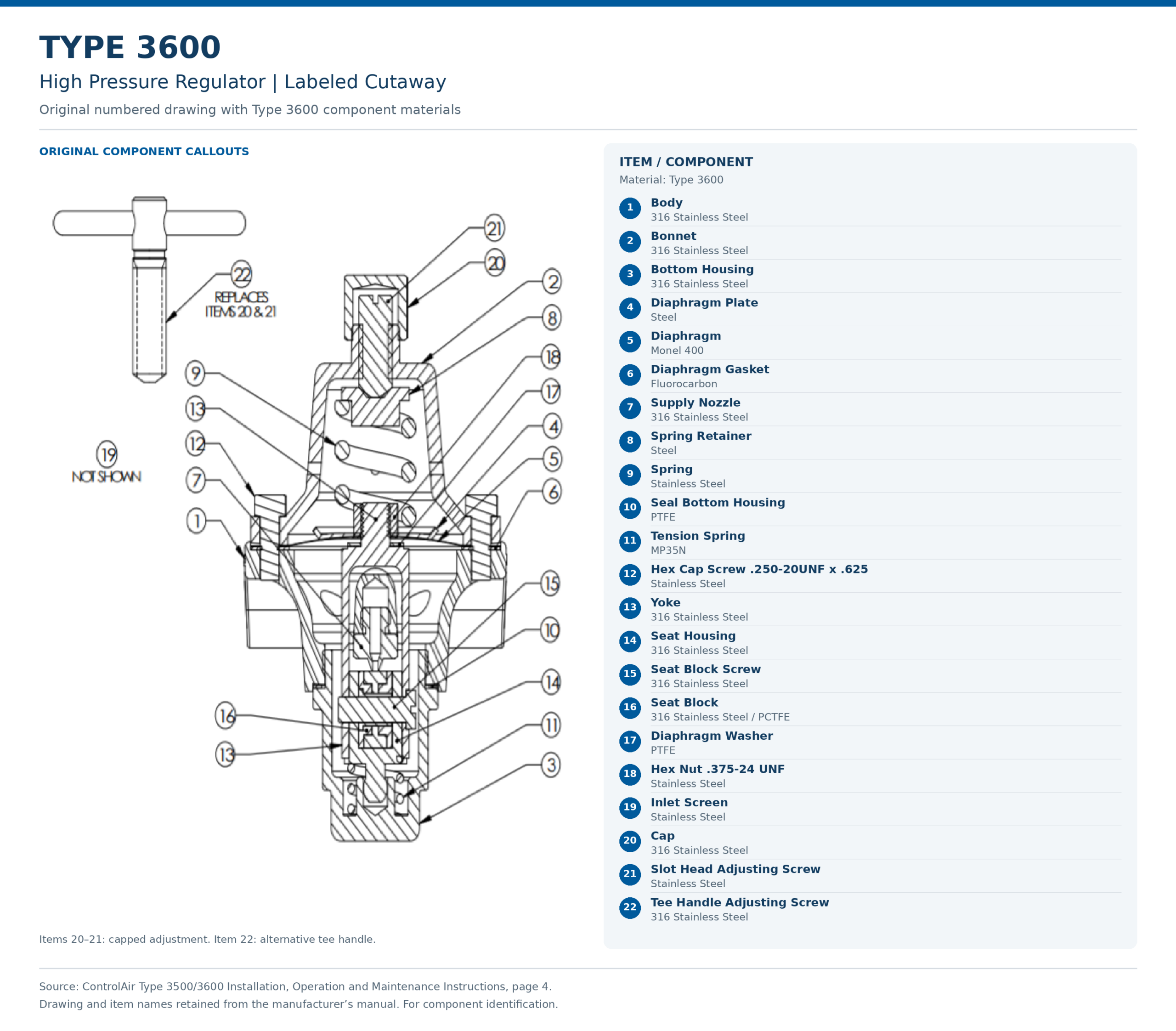
ControlAir Type 3600 regulator cutaway with labeled components and materials
Click the image to enlarge the component labels.

How Do Diaphragm and Seal Materials Affect Selection?

Common diaphragm and seal materials include nitrile, fluorocarbon, and silicone. Each material family has different characteristics, and individual compounds within a family can have different compatibility and temperature limits.

Diaphragm and Seal Materials: Selection Considerations
MaterialWhat to Review
Nitrile / Buna-N / NBRConfirm compatibility with the specific gas, contaminants, and temperature range rather than assuming suitability from compressed-air service.
Fluorocarbon / FKMCheck the exact compound and operating conditions. FKM is not a universal replacement for every gas or chemical.
SiliconeWhen considering a low-temperature option, verify both gas compatibility and the complete regulator’s temperature rating.

Use chemical compatibility references as a starting point, then confirm the selected regulator configuration with the manufacturer. A material chart does not establish the suitability of the complete assembly.

How Should You Choose the Regulator Body Material?

Pressure regulator bodies may be made from aluminum, zinc, brass, plastics, or stainless steel. Evaluate the body for both internal gas exposure and external conditions such as moisture, salt air, and washdown chemicals.

Stainless steel regulators can be useful in corrosive environments. However, a stainless steel body does not establish compatibility for the diaphragm, seals, valve seat, or other internal parts.

What Requires Special Attention in Oxygen or Sour Gas Service?

Oxygen Service

Oxygen applications require a regulator specifically suitable for the intended service, including appropriate materials and cleaning requirements. Do not assume that a standard compressed-air regulator or a stainless steel model is ready for oxygen use.

Sour Gas Service

Sour gas contains hydrogen sulfide and requires review of the gas composition and operating conditions. Identify any applicable NACE MR0175 requirements and confirm that the selected regulator materials and configuration meet the application requirements.

Should the Regulator Be Relieving or Non-Relieving?

A relieving regulator can discharge gas through an internal exhaust path to reduce downstream pressure. That discharge must be considered when the gas is hazardous, flammable, or otherwise unsuitable for release into the surrounding area.

A non-relieving regulator does not provide this internal downstream relief function. If the pressure setting is lowered while downstream flow is stopped, trapped pressure must decrease through another suitable path.

Also check for continuous bleed or other vent paths. A non-relieving designation alone does not establish that the entire device has no gas emissions. Where remote venting is required, confirm that the selected model provides suitable connections and follow its installation instructions.

Read more about relieving and non-relieving regulators.

What Information Should You Provide Before Selecting a Gas Regulator?

  • Gas composition, including moisture and contaminants.
  • Minimum and maximum inlet pressure.
  • Required outlet pressure and flow.
  • Gas and ambient temperature ranges.
  • External environmental conditions.
  • Allowable bleed, exhaust, and vent-routing requirements.
  • Applicable material, cleaning, and service requirements.

Related ControlAir Regulators

The Type 360 Stainless Steel Pressure Regulator offers corrosion-resistant construction and configurations for demanding gas applications. Review the available materials, pressure limits, and exhaust options for your installation.

The Type 3600 High Pressure Regulator provides a stainless steel, non-relieving option for first-stage pressure reduction. Its product specifications identify NACE MR0175 requirements for sour gas service.

Need help matching a regulator to your gas? Share your gas composition, pressure, flow, temperature, and venting requirements with ControlAir’s technical sales team, or explore our gas regulators.


Post navigation

 Choosing the Correct Regulator: Part I – PressureNew Miniature Back Pressure Regulator 

Ask an Expert

Contact our technical experts for help with your pneumatic application or ControlAir Product.

Question

First Name*

Last Name*

Email*

Company*

Country*

State/Province*

City*

How did you hear about us*

Click here if you want to be on our mailing list

I accept the terms of our Data Privacy Policy.

Data Privacy Policy

ControlAir’s purpose to collect any personal data is to respond to your request for product help, quotation and processing of orders. We take your privacy seriously. Here are some relevant questions and answers regarding our collection and use of personal data.

What information is being collected?

ControlAir will collect names, email addresses, phone numbers and local addresses so we may fulfill your request for product help, quotes or order shipment.

Who is collecting it?

ControlAir has a sales and marketing department that oversees the collection and use of this data. We do use a Customer Relationship Management system to process this information.

How is it collected?

Data is collected using our Webforms (Get a Quote, Ask the Expert, White Paper Sign Up, etc), via phone calls, incoming emails and during any email campaigns that are sent to you for marketing purposes.

Why is it being collected?

This information is being collected for the purpose to respond to your request and for later follow up to ensure that we provided you with a good customer experience. This information may be used to contact you in the future regarding ControlAir products.

How will it be used?

This information will be entered into a CRM database, so we can contact you via email, phone or mail to fulfill your request and follow up with appropriate product information.

Who will it be shared with?

Your information will not be sold to a third party. Your information maybe shared with one of our local partners (distributors and/or local field agent) so we can fulfill your request for product information and quotation.

What will be the effect of this on the individuals concerned?

The purpose of transferring this information to these individuals/companies will be to fulfill your request for product information and quotation. You may receive emails to alert you of order, quote or shipment status. You may also receive follow up emails to gauge your customer experience and alert you to product information.

Is the intended use likely to cause individuals to object or complain?

We do not expect individuals to object with the use of this data to fulfill an action that they requested of ControlAir. We will remove persons from any future emails if they choose to opt out of future emails.

Please let us know if you have any further questions regarding the processing and use of your information. We can be reached at 1-603-886-9400 or by email at [email protected]

Lead Source

Enter the Captcha*

captcha Reload
Call (800) 216-3636

Related Products

  • Type 3600 High Pressure Regulator

  • Type 360 Stainless Steel Pressure Regulator

Sign up for the ControlAir newsletter.

Get news, updates, and offers direct to your inbox.

Industries We Serve
  • Food & Beverage
  • Oil & Gas
  • Control Valve
  • Water Treatment

Products

  • Pressure Regulators
  • Back Pressure Regulators
  • Filter Regulators
  • Precision Pressure Regulators
  • Pressure Regulators
  • Stainless Steel Pressure Regulators
  • Potable Water Pressure Regulators
  • Brackets, Gauges, & Accessories
  • Electronic Pressure Regulators
  • Pressure Transducers
  • I/P Transducers (current-to-pressure)
  • E/P Transducers (voltage-to-pressure)
  • P/I Transducers (pressure-to-current)
  • I/PAC Integrated Process Air Control
  • Supply Manifold
  • Brackets, Gauges, & Accessories
  • Diaphragm Air Cylinders
  • Rolling Diaphragm Cylinder
  • Small Bore Compact Cylinder
  • Mini Might Cylinders
  • Pneumatic Air Filters
  • Air Relays
  • Vacuum Regulators
  • Valve Positioners
  • Volume Boosters
  • Stainless Steel Volume Boosters
  • No-Brass Products
  • View All Products
Resources
  • Blog
  • CAD Models
  • Certifications
  • Catalogs
  • FAQ
  • How to Determine the Appropriate Regulator
  • Product Selection Guides
  • Whitepapers
  • Visual Product Reference Guide
  • Videos

ControlAir

International HQ
8 Columbia Dr
Amherst, NH 03031 USA

603-886-9400
1 (800) 216-3636
Send us a message


Privacy Policy | Site Map | © 2019 ControlAir. All rights reserved

We use cookies on our website to give you the most relevant experience by remembering your preferences and repeat visits. By clicking “Accept”, you consent to the use of ALL the cookies.
In case of sale of your personal information, you may opt out by using the link Do not sell my personal information.
Cookie settingsACCEPT
Manage consent

Privacy Overview

This website uses cookies to improve your experience while you navigate through the website. Out of these cookies, the cookies that are categorized as necessary are stored on your browser as they are essential for the working of basic functionalities of the website. We also use third-party cookies that help us analyze and understand how you use this website. These cookies will be stored in your browser only with your consent. You also have the option to opt-out of these cookies. But opting out of some of these cookies may have an effect on your browsing experience.
Necessary
Always Enabled
Necessary cookies are absolutely essential for the website to function properly. These cookies ensure basic functionalities and security features of the website, anonymously.
CookieDurationDescription
cookielawinfo-checkbox-analytics11 monthsThis cookie is set by GDPR Cookie Consent plugin. The cookie is used to store the user consent for the cookies in the category "Analytics".
cookielawinfo-checkbox-functional11 monthsThe cookie is set by GDPR cookie consent to record the user consent for the cookies in the category "Functional".
cookielawinfo-checkbox-necessary11 monthsThis cookie is set by GDPR Cookie Consent plugin. The cookies is used to store the user consent for the cookies in the category "Necessary".
cookielawinfo-checkbox-others11 monthsThis cookie is set by GDPR Cookie Consent plugin. The cookie is used to store the user consent for the cookies in the category "Other.
cookielawinfo-checkbox-performance11 monthsThis cookie is set by GDPR Cookie Consent plugin. The cookie is used to store the user consent for the cookies in the category "Performance".
viewed_cookie_policy11 monthsThe cookie is set by the GDPR Cookie Consent plugin and is used to store whether or not user has consented to the use of cookies. It does not store any personal data.
Functional
Functional cookies help to perform certain functionalities like sharing the content of the website on social media platforms, collect feedbacks, and other third-party features.
Performance
Performance cookies are used to understand and analyze the key performance indexes of the website which helps in delivering a better user experience for the visitors.
Analytics
Analytical cookies are used to understand how visitors interact with the website. These cookies help provide information on metrics the number of visitors, bounce rate, traffic source, etc.
Advertisement
Advertisement cookies are used to provide visitors with relevant ads and marketing campaigns. These cookies track visitors across websites and collect information to provide customized ads.
Others
Other uncategorized cookies are those that are being analyzed and have not been classified into a category as yet.
Save & Accept