Sign up for the ControlAir newsletter.
Get news, updates, and offers direct to your inbox.
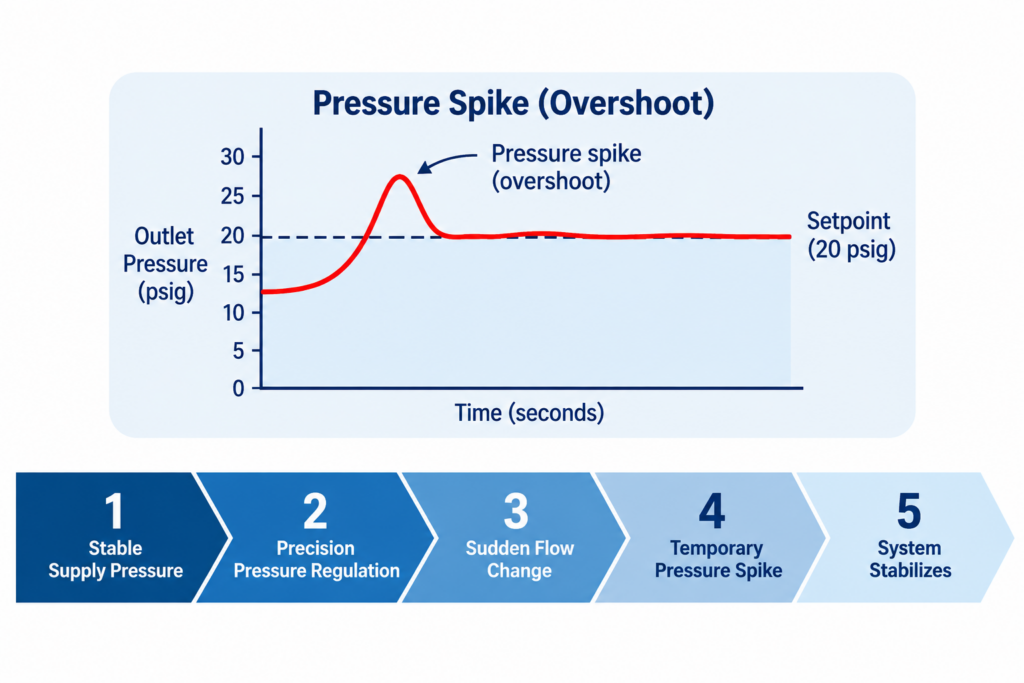
Pressure spikes, also called pressure overshoot, occur when the pressure in a pneumatic system temporarily rises above the desired setpoint. They often happen when downstream flow changes suddenly, such as when a valve opens or a pneumatic device begins consuming air.
While the pressure regulator may appear to be the source of the problem, pressure spikes are often caused by the interaction between the regulator, inlet pressure, flow demand, tubing, valves and downstream volume.
For applications requiring especially stable and accurate pressure control, selecting the right precision pressure regulator and properly designing the pneumatic system can significantly reduce pressure fluctuations.
A pressure regulator continuously responds to changes in downstream pressure and flow demand. When a downstream valve suddenly opens, pressure begins to fall and the regulator responds by opening its internal valve to supply additional flow.
If the regulator responds faster than the downstream system can absorb that flow, the outlet pressure can briefly rise above the setpoint before settling back to the desired pressure.
This pressure overshoot can be influenced by several factors:
Understanding the complete pneumatic system is usually the first step toward correcting the problem.
Bigger is not always better when selecting a pressure regulator.
An oversized regulator may have a large valve and high flow capacity compared with the actual requirements of the application. A relatively small movement of the valve can therefore introduce a significant amount of air into the downstream system.
This becomes particularly important when controlling very low pressures or low flow rates.
Regulator selection should consider:
ControlAir offers a range of precision pressure regulators designed for applications requiring accurate and repeatable pneumatic pressure control.
A regulator should have adequate supply pressure to provide the required downstream pressure and flow, but more pressure is not necessarily better.
Consider an application requiring only 1 psi outlet pressure while operating from a 100 psi supply. The regulator is controlling across a very large pressure differential. When downstream demand suddenly increases, even a small change in valve position can introduce a relatively large amount of energy into the system.
If the application does not require the full supply pressure, reducing the inlet pressure may improve dynamic stability.
For applications with a very large pressure reduction, two-stage regulation may be beneficial.
For example:
100 psi supply → First regulator at 20–30 psi → Precision regulator at 1 psi → Application
The first regulator reduces the major pressure differential, while the second regulator provides the final precision control.
A rapidly opening downstream valve can create a sudden change in demand.
The regulator responds to the pressure drop by increasing flow. If that response is too aggressive for the downstream system, pressure can temporarily overshoot the setpoint.
Depending on the application, consider:
Reducing abrupt changes in flow demand can improve overall system stability.
The regulator is only one component of the pneumatic system.
Tubing, fittings, filters, solenoid valves, quick disconnects and other components can create pressure drops when flow increases. The regulator may react to this pressure drop by opening further.
As the downstream system catches up, this can contribute to temporary pressure overshoot.
Check for:
Reducing unnecessary restrictions can improve the regulator’s ability to respond smoothly to changes in demand.
Downstream volume can have a significant effect on how quickly system pressure changes.
A very small downstream volume can experience a rapid pressure increase from a relatively small amount of incoming air. Adding additional downstream volume can sometimes damp short pressure disturbances.
However, additional volume will also increase filling and exhausting time.
The correct solution depends on whether the application requires extremely fast response, extremely stable pressure, or a balance between the two.
Pressure at the regulator outlet may not be the same as pressure at the actual process.
For example:
Regulator → 10 feet of tubing → Solenoid valve → Application
A pressure sensor installed immediately after the regulator may see a different transient than a sensor installed at the application.
When troubleshooting pressure spikes, determine:
For critical applications, measuring pressure close to the point of use can provide a much better picture of actual system performance.
Very low-pressure applications can be particularly sensitive to pressure variations.
A general-purpose regulator that performs well at 40, 60 or 80 psi may not provide the sensitivity required to accurately control pressures of only a few psi or fractions of a psi.
Precision regulators are designed to provide improved sensitivity, repeatability and pressure control for demanding pneumatic applications.
ControlAir’s precision pressure regulator family includes models for low-pressure, miniature, high-flow and other precision applications.
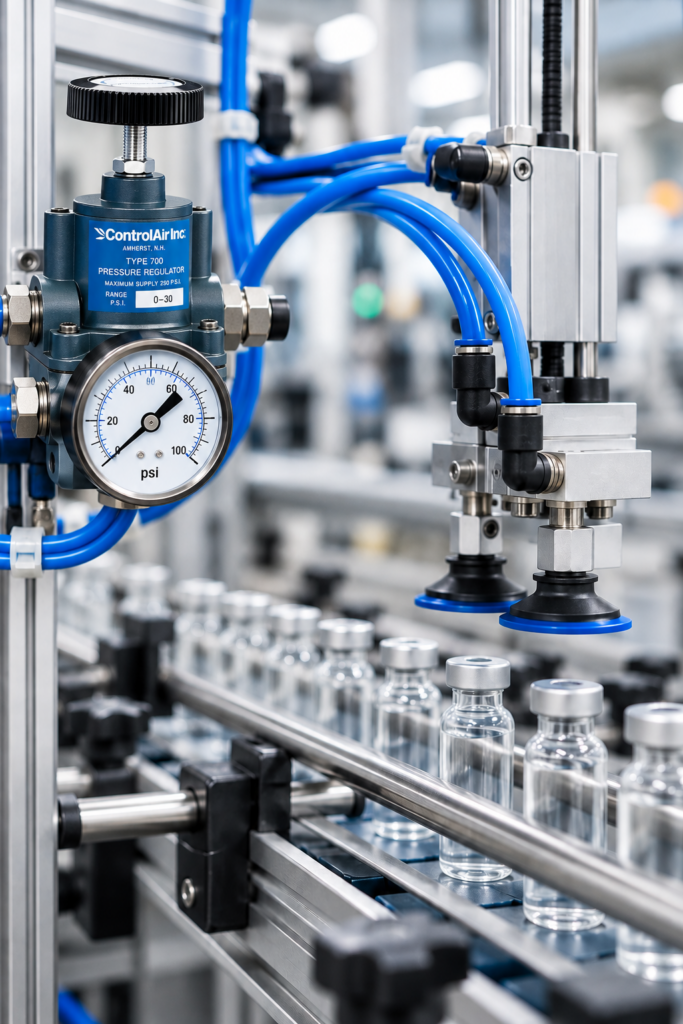
For applications requiring higher flow capacity combined with precision control, the ControlAir Type 700 Precision Air Pressure Regulator is one available option.
If a pneumatic system operated correctly in the past and pressure spikes suddenly appear, inspect the regulator and air supply.
Possible causes include:
Clean, properly filtered air can help maintain regulator performance and extend operating life.
When investigating pressure overshoot, gather as much information about the system as possible.
Start with these questions:
One useful troubleshooting test is to temporarily reduce the inlet pressure, provided sufficient pressure remains available to achieve the required flow.
If lowering the supply pressure significantly reduces the pressure spike, the high inlet-to-outlet pressure differential may be contributing to the problem.
When pressure overshoot occurs, replacing the regulator should not automatically be the first step.
Pneumatic pressure control is affected by the complete system. Regulator size, inlet pressure, downstream flow, tubing, valves, volume and measurement location all influence how the system responds.
Proper regulator selection and good pneumatic system design can improve pressure stability and help prevent unwanted pressure spikes.
If your application requires particularly accurate pressure control, review ControlAir’s Precision Pressure Regulators or review our guide on How to Determine the Appropriate Regulator.
A sudden increase in flow demand can cause a regulator to open rapidly. Depending on supply pressure, regulator size, downstream volume and restrictions, the outlet pressure may temporarily overshoot before settling at the desired setpoint.
A large difference between inlet and outlet pressure can contribute to difficult dynamic control, particularly in very low-pressure applications. Reducing inlet pressure or using two-stage pressure regulation may improve stability.
Yes. A regulator with substantially more flow capacity than the application requires may be more difficult to control at very low flow rates or pressures. Proper regulator sizing is important for stable performance.
A properly selected precision regulator can improve sensitivity and pressure stability, but the entire pneumatic system must be considered. Tubing, valves, flow demand, supply pressure and downstream volume can all contribute to pressure overshoot.
For critical applications, pressure should generally be measured as close as practical to the point where pressure control matters. Long tubing runs and restrictive components can cause pressure at the regulator outlet to differ from pressure at the process.