Sign up for the ControlAir newsletter.
Get news, updates, and offers direct to your inbox.
Pressure regulator ports must match both the connection size and thread standard used in your system. NPT, BSPP, and BSPT connections differ in thread form and sealing method. A matching nominal size alone does not establish compatibility.
This is Part III of ControlAir’s “Choosing the Correct Regulator” series. After reviewing pressure requirements and gas compatibility, the next step is selecting the appropriate port connections.
NPT is a tapered pipe thread. BSP includes parallel connections, commonly called BSPP, and tapered connections, commonly called BSPT. These thread families have different profiles and connection requirements.
| Connection | Thread Form | Thread Angle | Sealing Arrangement |
|---|---|---|---|
| NPT | Tapered | 60° | Thread engagement with appropriate sealant, following the manufacturer’s instructions. |
| BSPP / G | Parallel | 55° | A separate sealing feature, such as a gasket, bonded seal, or O-ring, as specified for the connection. |
| BSPT / ISO 7 | Tapered male thread; mating female thread depends on the specified connection. | 55° | Pressure-tight threaded joint with appropriate sealant and the correct mating thread. |
BSPP threads provide mechanical engagement; the pressure-tight seal is made at a separate sealing surface. Confirm that the fitting and regulator port provide compatible sealing geometry.
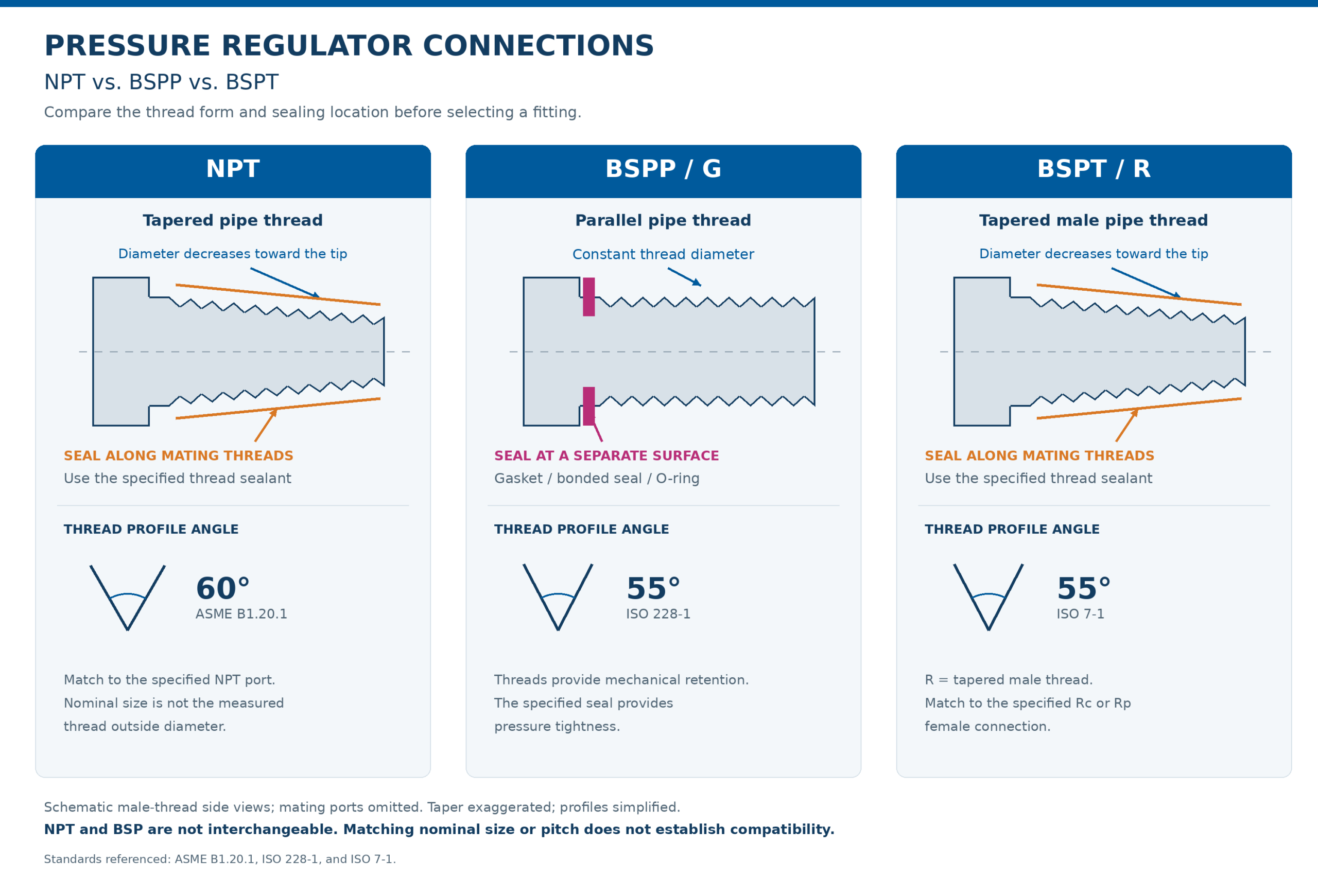
No. NPT and BSP connections should not be directly substituted for one another. Similar dimensions or partial thread engagement do not confirm compatibility.
For example, 1/2-inch NPT and 1/2-inch BSP threads both have 14 threads per inch, but their thread profiles differ. Matching pitch alone is not sufficient.
When converting between standards, use an adapter specified for both connection types and suitable for the application’s pressure, temperature, and media.
No. Labels such as 1/4 inch and 1/2 inch are nominal pipe-thread sizes. They do not represent the measured thread diameter or the regulator’s internal flow passage.
BSP connections also use nominal inch size designations. They should not be identified as metric threads simply because a diameter is measured in millimeters.
For replacement equipment, check the part number and connection drawing first. If measurement is necessary, identify the thread diameter, pitch, taper, and sealing arrangement together rather than relying on diameter alone.
A larger port can reduce restriction at the connection, but it does not automatically increase the regulator’s usable flow capacity. Internal valve geometry may remain the limiting factor.
Compare the regulator’s flow curves at the intended inlet pressure, outlet setting, and required flow. Pay attention to droop: the reduction in regulated outlet pressure as demand increases.
Also consider tubing, fittings, filters, and adapters. Their restrictions can affect the pressure available at the equipment.
For more detail, read Cv and Your Pressure Regulator and Choosing the Correct Regulator, Part IV: Flow.
Do not assume that every connection on a regulator has the same size or thread type. Review the drawing and ordering information for:
For each required connection, specify the nominal size, thread standard, and sealing requirements. Confirm that there is enough installation space for fittings and tubing.
Need help selecting a regulator connection? Contact ControlAir’s technical sales team with your required thread standard, port size, pressure, flow, and media. Explore our pressure regulators to compare available configurations.