Skip to content
Logo
×
Find a Distributor Request a Quote
  • Products
    • Pressure Regulators
    • Back Pressure Regulators
    • Filter Regulators
    • Gas Regulators
    • Precision Pressure Regulators
    • Pressure Regulators
    • Stainless Steel Pressure Regulators
    • Potable Water Pressure Regulators
    • Brackets, Gauges, & Accessories
    • Electronic Pressure Regulators
    • Pressure Transducers
    • I/P Transducers (current-to-pressure)
    • E/P Transducers (voltage-to-pressure)
    • P/I Transducers (pressure-to-current)
    • I/PAC Integrated Process Air Control
    • Supply Manifold
    • Brackets, Gauges, & Accessories
    • Diaphragm Air Cylinders
    • Rolling Diaphragm Cylinder
    • Small Bore Compact Cylinder
    • Mini Might Cylinders
    • Pneumatic Air Filters
    • Air Relays
    • Vacuum Regulators
    • Valve Positioners
    • Volume Boosters
    • Stainless Steel Volume Boosters
    • No-Brass Products
    • View All Products
  • Custom Solutions
  • Industries
    • Food and Beverage Processing Markets
    • Control Valve Products
    • Oil & Gas Markets
    • Waste Water Processing and Treatment
    • View All Industries
  • Engineers
  • Resources
    • Blog
    • CAD Models & Product Specifier
    • Certifications
    • Catalogs
    • FAQ
    • How to Determine the Appropriate Regulator
    • Instruction Manuals
    • Product Selection Guides
    • Visual Product Reference Guides
    • Videos
    • Volume Booster Sizing Guide
    • White Papers
  • Contact
    • Request a Quote
    • Ask an Expert
    • Contact
    • Request Help From Our Sales Team
  • About
    • About Us
    • News
    • Who We Help
    • Career Opportunities
  • Find a Distributor
  • Request a Quote
(603) 886-9400 | Distributor Login

Air Consumption in a Pressure Regulator: Exhaust, Bleed & Leakage Explained

Do pressure regulators consume air? The answer depends on the regulator design and operating conditions. Air can leave a pressure regulator through normal exhaust, intentional bleed, or unintended leakage.

Understanding the difference between these three types of air consumption is important when selecting a pressure regulator, particularly for applications involving compressed air, inert gases, specialty gases, or systems where minimizing air consumption is important.

In a typical pneumatic pressure regulator, there are three primary ways air or gas can escape:

  • Exhaust or relief
  • Designed-in bleed
  • Unintended leakage

Although each results in air leaving the system, they occur for very different reasons.

What Is Pressure Regulator Air Consumption?

Pressure regulator air consumption is the amount of compressed air or gas that leaves a regulator through intentional bleed, pressure-relieving exhaust, or unintended leakage.

Not every pressure regulator continuously consumes air. The amount of air consumption depends on the regulator’s design, whether it is relieving or non-relieving, and the requirements of the application.

Precision regulators, for example, may intentionally consume a small amount of air to improve pressure sensitivity, accuracy and repeatability.

Understanding where the air is going is the first step in determining whether air consumption is normal or indicates a problem.

What Causes Air to Escape From a Pressure Regulator?

Air generally leaves a pressure regulator in three ways: exhaust, bleed and leakage.

These terms are sometimes used interchangeably, but they describe different conditions.
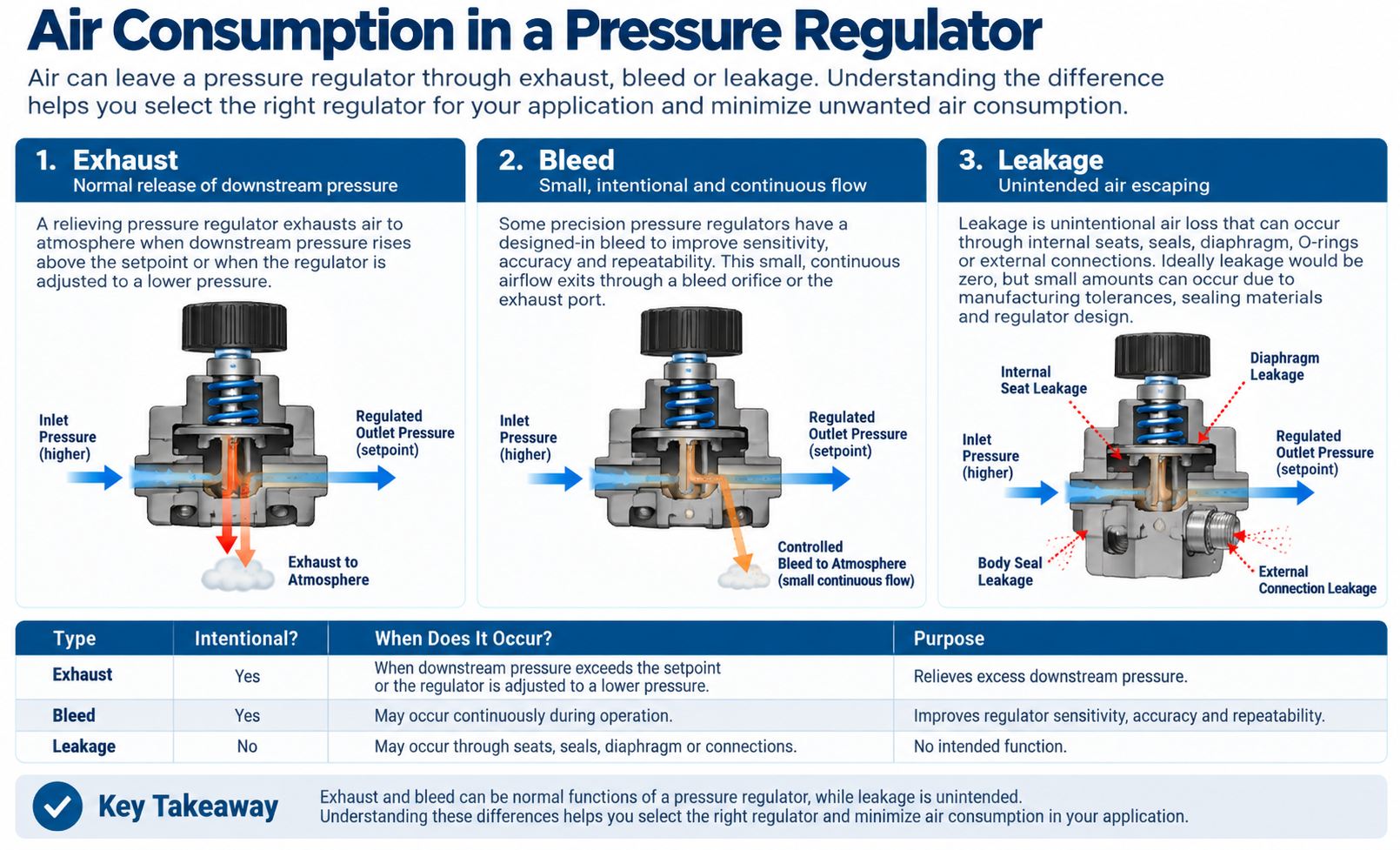
Pressure regulator air consumption showing exhaust, bleed and leakage

Pressure regulator air consumption can result from normal exhaust, designed-in bleed or unintended leakage.


Pressure Regulator Exhaust

Exhaust is the normal release of downstream pressure to atmosphere when pressure rises above the regulator setpoint or when the regulator is adjusted to a lower pressure.

This is a normal function of a relieving pressure regulator.  When the regulator is in a steady state condition, and there is still some exhaust, it maybe do to a damaged valve seat.  In some precision regulators, there will be a very small amount of air coming from the exhaust port.  This is intentional to put the regulator into a dynamic state to make the regulator more sensitive.

For example, if a regulator is maintaining 60 psig downstream and the regulator is adjusted to 40 psig, a relieving regulator can vent excess downstream pressure until the new pressure setting is reached.

A non-relieving pressure regulator, on the other hand, does not automatically vent downstream pressure to atmosphere.

When using a non-relieving regulator, downstream pressure must be reduced through normal system flow or by another pressure-relief device.

In applications where releasing air or gas directly into the surrounding environment is undesirable, a regulator with a tapped exhaust port can allow the exhaust to be captured and routed to an appropriate location.

What Is Bleed in a Pressure Regulator?

Bleed is a small, intentional and continuous flow of air incorporated into the design of some pressure regulators.

It is particularly common in certain precision pressure regulators.

The controlled bleed allows the regulator to continuously respond to very small pressure changes, which can improve:

  • Pressure accuracy
  • Sensitivity
  • Repeatability
  • Response to changing system conditions

This air typically exits through a small bleed orifice or through the regulator’s exhaust port.

Because the bleed is intentionally designed into the regulator, a small continuous airflow does not necessarily mean the regulator is leaking or malfunctioning.

This distinction is particularly important when troubleshooting precision pneumatic systems.

What Is Pressure Regulator Leakage?

Leakage is unintended air or gas escaping from a pressure regulator through internal valve seats, relief seats, seals or external connections.

Ideally, leakage would be zero. In actual pneumatic components, however, manufacturing tolerances, sealing materials, elastomer compression and regulator design can result in a small amount of allowable leakage.

Potential leakage paths include:

  • Relief valve seats
  • Main valve seats
  • Diaphragm seals
  • O-rings and other elastomer seals
  • Threaded connections
  • External body seals

The acceptable amount of leakage depends heavily on the application.

A small amount of leakage that is acceptable in a general industrial compressed-air application may not be acceptable when controlling an expensive specialty gas or in an application requiring extremely low leakage.

Exhaust vs. Bleed vs. Leakage

These three terms describe very different types of pressure regulator air consumption:

Exhaust vs. Bleed vs. Leakage

These three terms describe very different types of pressure regulator air consumption:

TypeIntentional?When Does It Occur?Purpose
ExhaustYesWhen downstream pressure exceeds the setpointRelieves excess downstream pressure
BleedYesMay occur continuously during operationImproves regulator sensitivity and performance
LeakageNoMay occur through seats, seals or connectionsNo intended function

The important distinction is that exhaust and bleed can be normal regulator functions, while leakage is unintended.

Relieving vs. Non-Relieving Pressure Regulators

One of the most important considerations when evaluating regulator air consumption is whether the regulator is relieving or non-relieving.

Relieving Pressure Regulator

A relieving regulator can vent excess downstream pressure through its exhaust.

If downstream pressure rises above the regulator setpoint—or the pressure setting is reduced—the regulator can automatically relieve the excess pressure.

Non-Relieving Pressure Regulator

A non-relieving regulator does not vent downstream pressure to atmosphere.

If downstream pressure rises above the setpoint, the pressure must be reduced through downstream consumption, system flow or a separate relief device.

Non-relieving regulators can be advantageous when the regulated media should not be released into the surrounding environment.

Do Precision Pressure Regulators Consume Air?

Some precision pressure regulators intentionally consume a small amount of air through a designed-in bleed.

This controlled airflow can help the regulator respond to extremely small changes in pressure and provide greater sensitivity, accuracy and repeatability.

However, not all precision regulators have the same air-consumption characteristics.

When compressed-air consumption, gas cost or environmental considerations are important, regulator bleed specifications should be considered during product selection.

A regulator with some designed-in bleed should therefore not automatically be ruled out. The required pressure-control performance should be considered alongside the amount and cost of the gas being consumed.

Why Is My Pressure Regulator Leaking Air?

Air coming from a pressure regulator does not always indicate a leak.

Before assuming that the regulator has failed, determine where the air is coming from and under what operating conditions it occurs.

Air coming from the exhaust port may be normal if:

  • Downstream pressure has risen above the setpoint.
  • The pressure setting was recently reduced.
  • The regulator incorporates an intentional bleed.
  • Downstream equipment is creating pressure that must be relieved.

Air escaping continuously from an external seal, fitting or unintended location may indicate actual leakage.

If air consumption is unexpectedly high, inspect connections, seals and operating conditions and compare the regulator’s performance with the manufacturer’s specifications.

How Can Pressure Regulator Air Consumption Be Reduced?

Several regulator design options can help minimize air or gas consumption.

Use a non-relieving regulator when appropriate.
A non-relieving design prevents the regulator from intentionally exhausting downstream pressure.  These are usually used in steady flow applications.

Select a low-bleed regulator.
If precision regulation is required, compare the bleed or air-consumption specifications of available models.

Consider soft valve or relief seats.
Special sealing designs can help reduce leakage across regulator seats.

Use a tapped exhaust.
A tapped exhaust port allows exhaust or leakage through the relief seat to be captured and routed to another location.

Consider bubble-tight regulator designs.
Applications requiring extremely low leakage may require special sealing materials and manufacturing processes designed to achieve bubble-tight shutoff.

Properly size the regulator.
Selecting the appropriate regulator for the required pressure and flow can improve system performance and help avoid unnecessary pressure-control problems.

Why Air Consumption Matters

Minimizing unnecessary compressed-air consumption can improve overall pneumatic system efficiency.

Air consumption becomes particularly important when the regulated media is:

  • An inert gas
  • Nitrogen
  • Specialty or expensive gas
  • Process gas
  • A gas that should not be released into the surrounding environment

In these applications, regulator selection should consider not only pressure and flow requirements but also bleed rate, leakage specifications and exhaust characteristics.

How Do You Select the Right Pressure Regulator?

When selecting a pressure regulator, consider more than inlet pressure, outlet pressure and flow.

Important factors include:

  • Inlet and outlet pressure range
  • Required flow capacity
  • Pressure accuracy
  • Sensitivity and repeatability
  • Relieving vs. non-relieving design
  • Bleed or air-consumption rate
  • Allowable leakage
  • Media compatibility
  • Materials of construction
  • Exhaust requirements
  • Operating temperature

The correct regulator is the one that provides the required pressure-control performance while meeting the application’s allowable air or gas consumption.

Frequently Asked Questions About Pressure Regulator Air Consumption

Do pressure regulators continuously consume air?

Not necessarily. Some precision pressure regulators intentionally use a small continuous bleed to improve sensitivity and pressure-control performance, while other regulators have little or no designed-in continuous air consumption.

Why does a pressure regulator exhaust air?

A relieving pressure regulator exhausts air when downstream pressure exceeds the regulator’s setpoint. This may occur because downstream pressure increased or because the regulator was adjusted to a lower pressure setting.

Is air coming from a pressure regulator normal?

It can be. Air from the exhaust port may be normal pressure relief or intentional bleed. Continuous air escaping from an unintended location may indicate leakage.

What is the difference between bleed and leakage in a pressure regulator?

Bleed is an intentional airflow designed into certain regulators to improve performance. Leakage is unintended air or gas escaping through seals, valve seats or other components.

What is a non-relieving pressure regulator?

A non-relieving pressure regulator controls downstream pressure without automatically venting excess downstream pressure to atmosphere. Excess pressure must be removed through system flow or another relief method.

How can I reduce pressure regulator air consumption?

Select a regulator with appropriate bleed characteristics, consider a non-relieving design where suitable, use low-leakage or special sealing options when required, and properly size the regulator for the application.

Need Help Selecting a Pressure Regulator?

The appropriate pressure regulator depends on the application’s pressure range, flow requirements, accuracy, media and acceptable level of air consumption.

ControlAir offers a wide range of pressure regulators and precision pressure regulators for pneumatic and process applications. Contact ControlAir for assistance selecting the appropriate regulator for your application.

Post navigation

 What Is a Back Pressure Regulator? How It Works, Applications & SelectionHow to properly calibrate an I/P or E/P pressure transducer 

Ask an Expert

Contact our technical experts for help with your pneumatic application or ControlAir Product.

Question

First Name*

Last Name*

Email*

Company*

Country*

State/Province*

City*

How did you hear about us*

Click here if you want to be on our mailing list

I accept the terms of our Data Privacy Policy.

Data Privacy Policy

ControlAir’s purpose to collect any personal data is to respond to your request for product help, quotation and processing of orders. We take your privacy seriously. Here are some relevant questions and answers regarding our collection and use of personal data.

What information is being collected?

ControlAir will collect names, email addresses, phone numbers and local addresses so we may fulfill your request for product help, quotes or order shipment.

Who is collecting it?

ControlAir has a sales and marketing department that oversees the collection and use of this data. We do use a Customer Relationship Management system to process this information.

How is it collected?

Data is collected using our Webforms (Get a Quote, Ask the Expert, White Paper Sign Up, etc), via phone calls, incoming emails and during any email campaigns that are sent to you for marketing purposes.

Why is it being collected?

This information is being collected for the purpose to respond to your request and for later follow up to ensure that we provided you with a good customer experience. This information may be used to contact you in the future regarding ControlAir products.

How will it be used?

This information will be entered into a CRM database, so we can contact you via email, phone or mail to fulfill your request and follow up with appropriate product information.

Who will it be shared with?

Your information will not be sold to a third party. Your information maybe shared with one of our local partners (distributors and/or local field agent) so we can fulfill your request for product information and quotation.

What will be the effect of this on the individuals concerned?

The purpose of transferring this information to these individuals/companies will be to fulfill your request for product information and quotation. You may receive emails to alert you of order, quote or shipment status. You may also receive follow up emails to gauge your customer experience and alert you to product information.

Is the intended use likely to cause individuals to object or complain?

We do not expect individuals to object with the use of this data to fulfill an action that they requested of ControlAir. We will remove persons from any future emails if they choose to opt out of future emails.

Please let us know if you have any further questions regarding the processing and use of your information. We can be reached at 1-603-886-9400 or by email at [email protected]

Lead Source

Enter the Captcha*

captcha Reload
Call (800) 216-3636

Sign up for the ControlAir newsletter.

Get news, updates, and offers direct to your inbox.

Industries We Serve
  • Food & Beverage
  • Oil & Gas
  • Control Valve
  • Water Treatment

Products

  • Pressure Regulators
  • Back Pressure Regulators
  • Filter Regulators
  • Precision Pressure Regulators
  • Pressure Regulators
  • Stainless Steel Pressure Regulators
  • Potable Water Pressure Regulators
  • Brackets, Gauges, & Accessories
  • Electronic Pressure Regulators
  • Pressure Transducers
  • I/P Transducers (current-to-pressure)
  • E/P Transducers (voltage-to-pressure)
  • P/I Transducers (pressure-to-current)
  • I/PAC Integrated Process Air Control
  • Supply Manifold
  • Brackets, Gauges, & Accessories
  • Diaphragm Air Cylinders
  • Rolling Diaphragm Cylinder
  • Small Bore Compact Cylinder
  • Mini Might Cylinders
  • Pneumatic Air Filters
  • Air Relays
  • Vacuum Regulators
  • Valve Positioners
  • Volume Boosters
  • Stainless Steel Volume Boosters
  • No-Brass Products
  • View All Products
Resources
  • Blog
  • CAD Models
  • Certifications
  • Catalogs
  • FAQ
  • How to Determine the Appropriate Regulator
  • Product Selection Guides
  • Whitepapers
  • Visual Product Reference Guide
  • Videos

ControlAir

International HQ
8 Columbia Dr
Amherst, NH 03031 USA

603-886-9400
1 (800) 216-3636
Send us a message


Privacy Policy | Site Map | © 2019 ControlAir. All rights reserved

We use cookies on our website to give you the most relevant experience by remembering your preferences and repeat visits. By clicking “Accept”, you consent to the use of ALL the cookies.
In case of sale of your personal information, you may opt out by using the link Do not sell my personal information.
Cookie settingsACCEPT
Manage consent

Privacy Overview

This website uses cookies to improve your experience while you navigate through the website. Out of these cookies, the cookies that are categorized as necessary are stored on your browser as they are essential for the working of basic functionalities of the website. We also use third-party cookies that help us analyze and understand how you use this website. These cookies will be stored in your browser only with your consent. You also have the option to opt-out of these cookies. But opting out of some of these cookies may have an effect on your browsing experience.
Necessary
Always Enabled
Necessary cookies are absolutely essential for the website to function properly. These cookies ensure basic functionalities and security features of the website, anonymously.
CookieDurationDescription
cookielawinfo-checkbox-analytics11 monthsThis cookie is set by GDPR Cookie Consent plugin. The cookie is used to store the user consent for the cookies in the category "Analytics".
cookielawinfo-checkbox-functional11 monthsThe cookie is set by GDPR cookie consent to record the user consent for the cookies in the category "Functional".
cookielawinfo-checkbox-necessary11 monthsThis cookie is set by GDPR Cookie Consent plugin. The cookies is used to store the user consent for the cookies in the category "Necessary".
cookielawinfo-checkbox-others11 monthsThis cookie is set by GDPR Cookie Consent plugin. The cookie is used to store the user consent for the cookies in the category "Other.
cookielawinfo-checkbox-performance11 monthsThis cookie is set by GDPR Cookie Consent plugin. The cookie is used to store the user consent for the cookies in the category "Performance".
viewed_cookie_policy11 monthsThe cookie is set by the GDPR Cookie Consent plugin and is used to store whether or not user has consented to the use of cookies. It does not store any personal data.
Functional
Functional cookies help to perform certain functionalities like sharing the content of the website on social media platforms, collect feedbacks, and other third-party features.
Performance
Performance cookies are used to understand and analyze the key performance indexes of the website which helps in delivering a better user experience for the visitors.
Analytics
Analytical cookies are used to understand how visitors interact with the website. These cookies help provide information on metrics the number of visitors, bounce rate, traffic source, etc.
Advertisement
Advertisement cookies are used to provide visitors with relevant ads and marketing campaigns. These cookies track visitors across websites and collect information to provide customized ads.
Others
Other uncategorized cookies are those that are being analyzed and have not been classified into a category as yet.
Save & Accept