Skip to content
Logo
×
Find a Distributor Request a Quote
  • Products
    • Pressure Regulators
    • Back Pressure Regulators
    • Filter Regulators
    • Gas Regulators
    • Precision Pressure Regulators
    • Pressure Regulators
    • Stainless Steel Pressure Regulators
    • Potable Water Pressure Regulators
    • Brackets, Gauges, & Accessories
    • Electronic Pressure Regulators
    • Pressure Transducers
    • I/P Transducers (current-to-pressure)
    • E/P Transducers (voltage-to-pressure)
    • P/I Transducers (pressure-to-current)
    • I/PAC Integrated Process Air Control
    • Supply Manifold
    • Brackets, Gauges, & Accessories
    • Diaphragm Air Cylinders
    • Rolling Diaphragm Cylinder
    • Small Bore Compact Cylinder
    • Mini Might Cylinders
    • Pneumatic Air Filters
    • Air Relays
    • Vacuum Regulators
    • Valve Positioners
    • Volume Boosters
    • Stainless Steel Volume Boosters
    • No-Brass Products
    • View All Products
  • Custom Solutions
  • Industries
    • Food and Beverage Processing Markets
    • Control Valve Products
    • Oil & Gas Markets
    • Waste Water Processing and Treatment
    • View All Industries
  • Engineers
  • Resources
    • Blog
    • CAD Models & Product Specifier
    • Certifications
    • Catalogs
    • FAQ
    • How to Determine the Appropriate Regulator
    • Instruction Manuals
    • Product Selection Guides
    • Visual Product Reference Guides
    • Videos
    • Volume Booster Sizing Guide
    • White Papers
  • Contact
    • Request a Quote
    • Ask an Expert
    • Contact
    • Request Help From Our Sales Team
  • About
    • About Us
    • News
    • Who We Help
    • Career Opportunities
  • Find a Distributor
  • Request a Quote
(603) 886-9400 | Distributor Login

How to Prevent Pressure Spikes in a Pneumatic System

How to Prevent Pressure Spikes in a Pneumatic System   

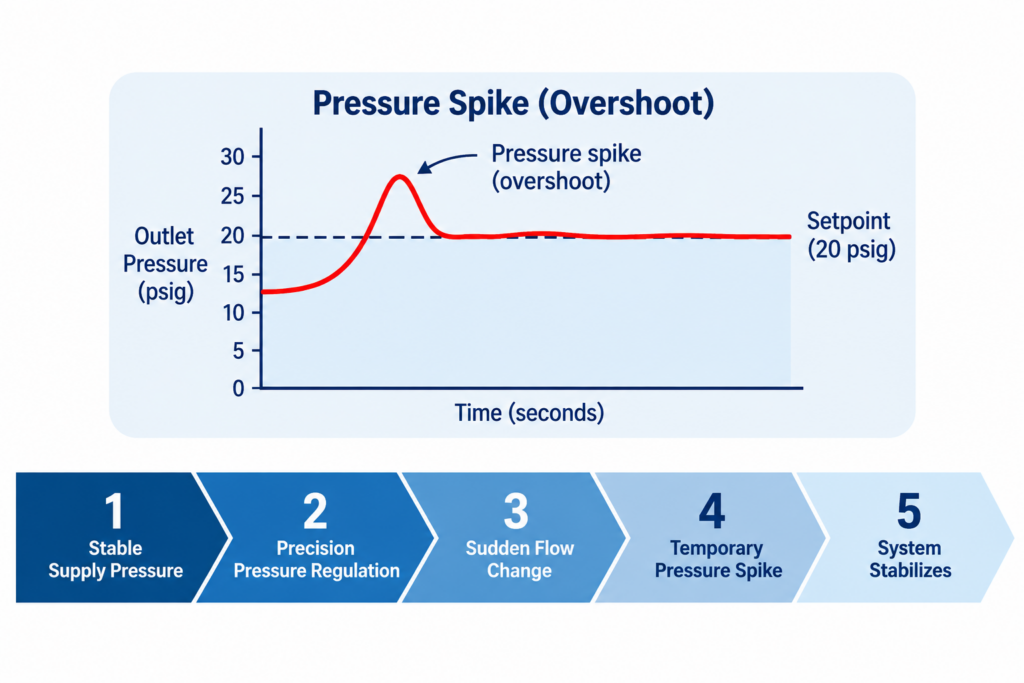
Pressure spikes, also called pressure overshoot, occur when the pressure in a pneumatic system temporarily rises above the desired setpoint. They often happen when downstream flow changes suddenly, such as when a valve opens or a pneumatic device begins consuming air.

While the pressure regulator may appear to be the source of the problem, pressure spikes are often caused by the interaction between the regulator, inlet pressure, flow demand, tubing, valves and downstream volume.

For applications requiring especially stable and accurate pressure control, selecting the right precision pressure regulator and properly designing the pneumatic system can significantly reduce pressure fluctuations.


What Causes a Pressure Spike in a Pneumatic System?

A pressure regulator continuously responds to changes in downstream pressure and flow demand. When a downstream valve suddenly opens, pressure begins to fall and the regulator responds by opening its internal valve to supply additional flow.

If the regulator responds faster than the downstream system can absorb that flow, the outlet pressure can briefly rise above the setpoint before settling back to the desired pressure.

This pressure overshoot can be influenced by several factors:

  • High inlet-to-outlet pressure differential
  • Rapid changes in downstream flow
  • An oversized regulator
  • Undersized tubing or restrictive fittings
  • Small downstream volume
  • Long pneumatic lines
  • Improper regulator selection
  • Contamination or mechanical problems inside the regulator

Understanding the complete pneumatic system is usually the first step toward correcting the problem.

1. Select the Correct Size Pressure Regulator

Bigger is not always better when selecting a pressure regulator.

An oversized regulator may have a large valve and high flow capacity compared with the actual requirements of the application. A relatively small movement of the valve can therefore introduce a significant amount of air into the downstream system.

This becomes particularly important when controlling very low pressures or low flow rates.

Regulator selection should consider:

  • Normal inlet pressure
  • Required outlet pressure
  • Minimum and maximum flow
  • Acceptable pressure droop
  • Required sensitivity
  • Port and tubing size
  • Expected changes in flow demand

ControlAir offers a range of precision pressure regulators designed for applications requiring accurate and repeatable pneumatic pressure control.

2. Avoid Excessive Supply Pressure

A regulator should have adequate supply pressure to provide the required downstream pressure and flow, but more pressure is not necessarily better.

Consider an application requiring only 1 psi outlet pressure while operating from a 100 psi supply. The regulator is controlling across a very large pressure differential. When downstream demand suddenly increases, even a small change in valve position can introduce a relatively large amount of energy into the system.

If the application does not require the full supply pressure, reducing the inlet pressure may improve dynamic stability.

Consider Two-Stage Pressure Regulation

For applications with a very large pressure reduction, two-stage regulation may be beneficial.

For example:

100 psi supply → First regulator at 20–30 psi → Precision regulator at 1 psi → Application

The first regulator reduces the major pressure differential, while the second regulator provides the final precision control.

3. Control How Quickly Flow Starts

A rapidly opening downstream valve can create a sudden change in demand.

The regulator responds to the pressure drop by increasing flow. If that response is too aggressive for the downstream system, pressure can temporarily overshoot the setpoint.

Depending on the application, consider:

  • A soft-start valve
  • A proportional valve
  • A controlled-opening valve
  • A flow control device
  • Slowing the rate at which the process is pressurized

Reducing abrupt changes in flow demand can improve overall system stability.

4. Check Tubing, Fittings and Other Restrictions

The regulator is only one component of the pneumatic system.

Tubing, fittings, filters, solenoid valves, quick disconnects and other components can create pressure drops when flow increases. The regulator may react to this pressure drop by opening further.

As the downstream system catches up, this can contribute to temporary pressure overshoot.

Check for:

  • Undersized tubing
  • Long tubing runs
  • Small fittings
  • Restrictive valves
  • Plugged or undersized filters
  • Excessive elbows or connections

Reducing unnecessary restrictions can improve the regulator’s ability to respond smoothly to changes in demand.

5. Consider Downstream Volume

Downstream volume can have a significant effect on how quickly system pressure changes.

A very small downstream volume can experience a rapid pressure increase from a relatively small amount of incoming air. Adding additional downstream volume can sometimes damp short pressure disturbances.

However, additional volume will also increase filling and exhausting time.

The correct solution depends on whether the application requires extremely fast response, extremely stable pressure, or a balance between the two.

6. Measure Pressure Where It Matters

Pressure at the regulator outlet may not be the same as pressure at the actual process.

For example:

Regulator → 10 feet of tubing → Solenoid valve → Application

A pressure sensor installed immediately after the regulator may see a different transient than a sensor installed at the application.

When troubleshooting pressure spikes, determine:

  • Where the pressure is being measured
  • Where the pressure spike matters to the process
  • What restrictions exist between those two locations

For critical applications, measuring pressure close to the point of use can provide a much better picture of actual system performance.

7. Use a Precision Regulator for Low-Pressure Applications

Very low-pressure applications can be particularly sensitive to pressure variations.

A general-purpose regulator that performs well at 40, 60 or 80 psi may not provide the sensitivity required to accurately control pressures of only a few psi or fractions of a psi.

Precision regulators are designed to provide improved sensitivity, repeatability and pressure control for demanding pneumatic applications.

ControlAir’s precision pressure regulator family includes models for low-pressure, miniature, high-flow and other precision applications.

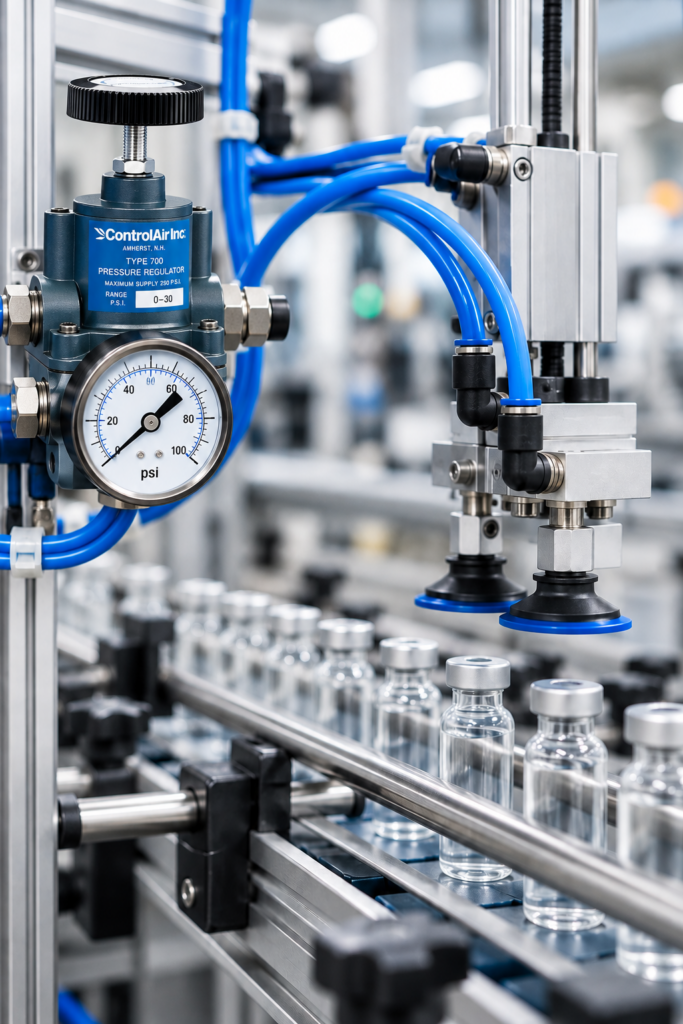
For applications requiring higher flow capacity combined with precision control, the ControlAir Type 700 Precision Air Pressure Regulator is one available option.

8. Check for Mechanical or Contamination Problems

If a pneumatic system operated correctly in the past and pressure spikes suddenly appear, inspect the regulator and air supply.

Possible causes include:

  • Dirt or contamination on the valve seat
  • A damaged valve seat
  • A sticking valve or pintle
  • Diaphragm damage
  • Internal friction
  • Oil or water contamination

Clean, properly filtered air can help maintain regulator performance and extend operating life.

How Do You Troubleshoot a Pneumatic Pressure Spike?

When investigating pressure overshoot, gather as much information about the system as possible.

Start with these questions:

  1. What is the normal inlet pressure?
  2. What is the desired outlet pressure?
  3. How high does the pressure spike?
  4. How long does the spike last?
  5. What is the normal and maximum flow rate?
  6. What causes flow to begin?
  7. What size and length tubing is being used?
  8. What valves or restrictions are downstream?
  9. Where is pressure being measured?
  10. Did the system always behave this way, or is the problem new?

One useful troubleshooting test is to temporarily reduce the inlet pressure, provided sufficient pressure remains available to achieve the required flow.

If lowering the supply pressure significantly reduces the pressure spike, the high inlet-to-outlet pressure differential may be contributing to the problem.

Pressure Spikes Are Often a System Problem

When pressure overshoot occurs, replacing the regulator should not automatically be the first step.

Pneumatic pressure control is affected by the complete system. Regulator size, inlet pressure, downstream flow, tubing, valves, volume and measurement location all influence how the system responds.

Proper regulator selection and good pneumatic system design can improve pressure stability and help prevent unwanted pressure spikes.

If your application requires particularly accurate pressure control, review ControlAir’s Precision Pressure Regulators or review our guide on How to Determine the Appropriate Regulator.

Frequently Asked Questions

What causes pressure spikes after a pneumatic valve opens?

A sudden increase in flow demand can cause a regulator to open rapidly. Depending on supply pressure, regulator size, downstream volume and restrictions, the outlet pressure may temporarily overshoot before settling at the desired setpoint.

Can high inlet pressure cause pressure overshoot?

A large difference between inlet and outlet pressure can contribute to difficult dynamic control, particularly in very low-pressure applications. Reducing inlet pressure or using two-stage pressure regulation may improve stability.

Can a pressure regulator be too large?

Yes. A regulator with substantially more flow capacity than the application requires may be more difficult to control at very low flow rates or pressures. Proper regulator sizing is important for stable performance.

Will a precision pressure regulator eliminate pressure spikes?

A properly selected precision regulator can improve sensitivity and pressure stability, but the entire pneumatic system must be considered. Tubing, valves, flow demand, supply pressure and downstream volume can all contribute to pressure overshoot.

Where should pressure be measured in a pneumatic system?

For critical applications, pressure should generally be measured as close as practical to the point where pressure control matters. Long tubing runs and restrictive components can cause pressure at the regulator outlet to differ from pressure at the process.


Post navigation

 New Type 385 Stainless Steel FilterNew Type 625 Volume Booster 

Ask an Expert

Contact our technical experts for help with your pneumatic application or ControlAir Product.

Question

First Name*

Last Name*

Email*

Company*

Country*

State/Province*

City*

How did you hear about us*

Click here if you want to be on our mailing list

I accept the terms of our Data Privacy Policy.

Data Privacy Policy

ControlAir’s purpose to collect any personal data is to respond to your request for product help, quotation and processing of orders. We take your privacy seriously. Here are some relevant questions and answers regarding our collection and use of personal data.

What information is being collected?

ControlAir will collect names, email addresses, phone numbers and local addresses so we may fulfill your request for product help, quotes or order shipment.

Who is collecting it?

ControlAir has a sales and marketing department that oversees the collection and use of this data. We do use a Customer Relationship Management system to process this information.

How is it collected?

Data is collected using our Webforms (Get a Quote, Ask the Expert, White Paper Sign Up, etc), via phone calls, incoming emails and during any email campaigns that are sent to you for marketing purposes.

Why is it being collected?

This information is being collected for the purpose to respond to your request and for later follow up to ensure that we provided you with a good customer experience. This information may be used to contact you in the future regarding ControlAir products.

How will it be used?

This information will be entered into a CRM database, so we can contact you via email, phone or mail to fulfill your request and follow up with appropriate product information.

Who will it be shared with?

Your information will not be sold to a third party. Your information maybe shared with one of our local partners (distributors and/or local field agent) so we can fulfill your request for product information and quotation.

What will be the effect of this on the individuals concerned?

The purpose of transferring this information to these individuals/companies will be to fulfill your request for product information and quotation. You may receive emails to alert you of order, quote or shipment status. You may also receive follow up emails to gauge your customer experience and alert you to product information.

Is the intended use likely to cause individuals to object or complain?

We do not expect individuals to object with the use of this data to fulfill an action that they requested of ControlAir. We will remove persons from any future emails if they choose to opt out of future emails.

Please let us know if you have any further questions regarding the processing and use of your information. We can be reached at 1-603-886-9400 or by email at [email protected]

Lead Source

Enter the Captcha*

captcha Reload
Call (800) 216-3636

Sign up for the ControlAir newsletter.

Get news, updates, and offers direct to your inbox.
Industries We Serve
  • Food & Beverage
  • Oil & Gas
  • Control Valve
  • Water Treatment

Products

  • Pressure Regulators
  • Back Pressure Regulators
  • Filter Regulators
  • Precision Pressure Regulators
  • Pressure Regulators
  • Stainless Steel Pressure Regulators
  • Potable Water Pressure Regulators
  • Brackets, Gauges, & Accessories
  • Electronic Pressure Regulators
  • Pressure Transducers
  • I/P Transducers (current-to-pressure)
  • E/P Transducers (voltage-to-pressure)
  • P/I Transducers (pressure-to-current)
  • I/PAC Integrated Process Air Control
  • Supply Manifold
  • Brackets, Gauges, & Accessories
  • Diaphragm Air Cylinders
  • Rolling Diaphragm Cylinder
  • Small Bore Compact Cylinder
  • Mini Might Cylinders
  • Pneumatic Air Filters
  • Air Relays
  • Vacuum Regulators
  • Valve Positioners
  • Volume Boosters
  • Stainless Steel Volume Boosters
  • No-Brass Products
  • View All Products
Resources
  • Blog
  • CAD Models
  • Certifications
  • Catalogs
  • FAQ
  • How to Determine the Appropriate Regulator
  • Product Selection Guides
  • Whitepapers
  • Visual Product Reference Guide
  • Videos

ControlAir

International HQ
8 Columbia Dr
Amherst, NH 03031 USA

603-886-9400
1 (800) 216-3636
Send us a message


Privacy Policy | Site Map | © 2019 ControlAir. All rights reserved

We use cookies on our website to give you the most relevant experience by remembering your preferences and repeat visits. By clicking “Accept”, you consent to the use of ALL the cookies.
In case of sale of your personal information, you may opt out by using the link Do not sell my personal information.
Cookie settingsACCEPT
Manage consent

Privacy Overview

This website uses cookies to improve your experience while you navigate through the website. Out of these cookies, the cookies that are categorized as necessary are stored on your browser as they are essential for the working of basic functionalities of the website. We also use third-party cookies that help us analyze and understand how you use this website. These cookies will be stored in your browser only with your consent. You also have the option to opt-out of these cookies. But opting out of some of these cookies may have an effect on your browsing experience.
Necessary
Always Enabled
Necessary cookies are absolutely essential for the website to function properly. These cookies ensure basic functionalities and security features of the website, anonymously.
CookieDurationDescription
cookielawinfo-checkbox-analytics11 monthsThis cookie is set by GDPR Cookie Consent plugin. The cookie is used to store the user consent for the cookies in the category "Analytics".
cookielawinfo-checkbox-functional11 monthsThe cookie is set by GDPR cookie consent to record the user consent for the cookies in the category "Functional".
cookielawinfo-checkbox-necessary11 monthsThis cookie is set by GDPR Cookie Consent plugin. The cookies is used to store the user consent for the cookies in the category "Necessary".
cookielawinfo-checkbox-others11 monthsThis cookie is set by GDPR Cookie Consent plugin. The cookie is used to store the user consent for the cookies in the category "Other.
cookielawinfo-checkbox-performance11 monthsThis cookie is set by GDPR Cookie Consent plugin. The cookie is used to store the user consent for the cookies in the category "Performance".
viewed_cookie_policy11 monthsThe cookie is set by the GDPR Cookie Consent plugin and is used to store whether or not user has consented to the use of cookies. It does not store any personal data.
Functional
Functional cookies help to perform certain functionalities like sharing the content of the website on social media platforms, collect feedbacks, and other third-party features.
Performance
Performance cookies are used to understand and analyze the key performance indexes of the website which helps in delivering a better user experience for the visitors.
Analytics
Analytical cookies are used to understand how visitors interact with the website. These cookies help provide information on metrics the number of visitors, bounce rate, traffic source, etc.
Advertisement
Advertisement cookies are used to provide visitors with relevant ads and marketing campaigns. These cookies track visitors across websites and collect information to provide customized ads.
Others
Other uncategorized cookies are those that are being analyzed and have not been classified into a category as yet.
Save & Accept