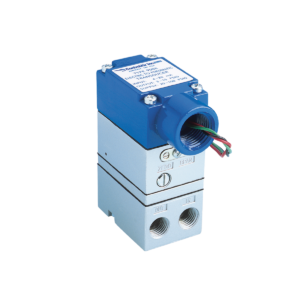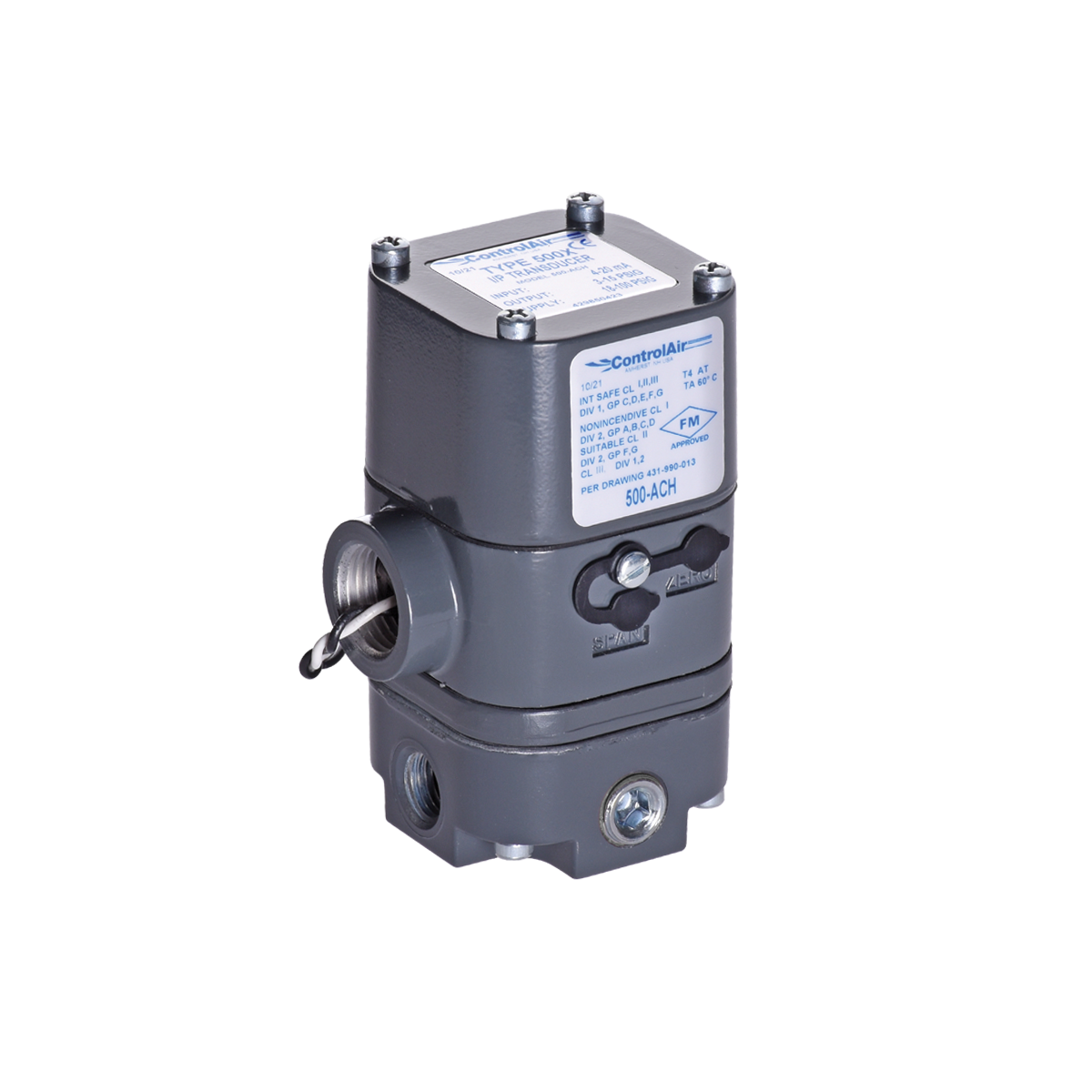



Description
Overview
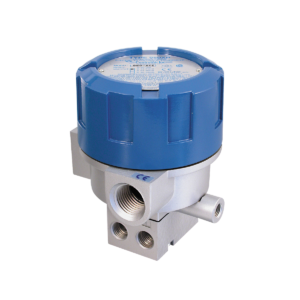
The Type 500X Electropneumatic Transducer converts a current or voltage input signal into a linearly proportional pneumatic output pressure. Available as both an I/P transducer for current input and an E/P transducer for voltage input, the Type 500X provides reliable and repeatable electrical-to-pneumatic signal conversion at an economical cost.
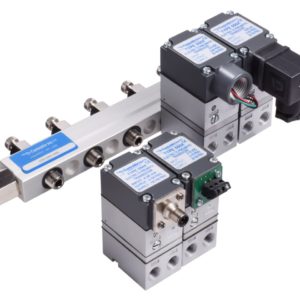
An integral volume booster supplies the flow capacity required to operate pneumatic valve actuators, valve positioners, dampers, louvers, air cylinders, web tensioners, clutches, brakes, and other final control elements. Standard-range models support common process-control pressures, while high-output versions provide pneumatic outputs up to 120 psig as factory calibrated and can be recalibrated for outputs as high as 145 psig.
The Type 500X is available in general-purpose and FM Approved intrinsically safe configurations. An optional NEMA 4X/IP65 enclosure supports outdoor and splashdown installations, while external zero and span adjustments simplify calibration and field setup.
Key Features
- Converts current or voltage input signals to proportional pneumatic pressure
- Available as an I/P or E/P transducer
- Economical and reliable electrical-to-pneumatic conversion
- Integral volume booster for improved flow capacity
- Compact, space-saving design
- Low air consumption
- External zero and span adjustments
- Standard industrial process inputs
- Standard and high-output pressure configurations
- Split-ranging capability
- Field-reversible operation on general-purpose models
- Conduit or DIN 43650 electrical connections
- Optional NEMA 4X/IP65 enclosure
- FM Approved intrinsically safe configuration available
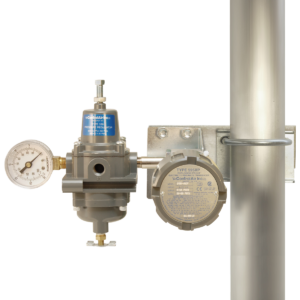
- Pipe, panel, or bracket mounting
Performance Characteristics
- Input Signals: 4-20 mA, 0-5 VDC, 1-9 VDC, or 0-10 VDC, depending on model
- Standard Output Ranges: 3-9 psig, 9-15 psig, 3-15 psig, 3-27 psig, 6-30 psig, and 1-17 psig
- High-Output Ranges: 2-60 psig and 3-120 psig
- Maximum Supply Pressure: 150 psig (10 bar)
- Standard-Range Flow Rate: 4.5 scfm at 25 psig supply and 12 scfm at 100 psig supply
- High-Output Flow Rate: 20 scfm at 150 psig supply
- Maximum Air Consumption: 0.05 scfm typical for standard-range models and 0.07 scfm typical for high-output models
- Response Time: Typically less than 0.25 seconds for 3-15 psig units
- Standard-Range Relief Capacity: 2 scfm at 5 psig above a 20 psig setpoint
- High-Output Relief Capacity: 7 scfm at 10 psig above a 20 psig setpoint
- Standard-Range Linearity: Less than ±0.75% of span
- High-Output Linearity: Less than ±1.5% of span typical and ±2.0% maximum
- Standard-Range Hysteresis: Less than 1.0% of span
- High-Output Hysteresis: Less than 0.5% of span
- Repeatability: Less than 0.5% of span
- Operating Temperature: -20°F to 140°F (-30°C to 60°C)
- Pneumatic Ports: 1/4″ NPT with optional 1/4″ BSP
- Electrical Connection: 1/2″ NPT conduit or optional DIN 43650
- Operating Media: Oil-free, clean, dry air filtered to 40 microns
- Enclosure: NEMA 1 standard; NEMA 4X/IP65 optional or standard with intrinsically safe configuration
- Weight: 2.1 lbs (0.94 kg)
The force-balance operating principle uses a coil suspended in a magnetic field. As the electrical input changes, the coil and flexure move relative to the nozzle, creating a pilot pressure that controls the integral booster relay and produces a proportional pneumatic output.
How to Select the Right Configuration
Selecting the correct Type 500X configuration depends on the available electrical signal, required pneumatic output range, supply pressure, enclosure, electrical connection, hazardous-area classification, and acting direction.
- Select a 4-20 mA input model for standard I/P process-control applications.
- Select a 0-5 VDC, 1-9 VDC, or 0-10 VDC model for E/P voltage-input applications.
- Choose a standard-range model for common outputs such as 3-15 psig.
- Choose a high-output model when the application requires output pressure up to 60 or 120 psig.
- Select reverse-acting output when increasing electrical input must decrease pneumatic pressure.
- Use split ranging when one 4-20 mA input must control a 3-9 psig or 9-15 psig output range.
- Choose the DIN 43650 option when a detachable electrical connector is preferred.
- Choose the NEMA 4X/IP65 option for outdoor, splashdown, or washdown-prone environments.
- Select the FM Approved intrinsically safe model for qualifying hazardous-area applications.
- Select BSP pneumatic porting when required by the piping standard.
- Mount the unit vertically in a low-vibration area whenever possible for best stability.
- Verify that the available supply pressure meets the requirement for the selected output range.
For additional guidance:
Applications
The Type 500X is used in industrial control applications that require dependable conversion of an electrical command signal into a proportional pneumatic pressure.
- Pneumatic valve actuators
- Valve positioners
- Damper and louver actuators
- Final control elements
- Pneumatic relays
- Air cylinders
- Web tensioning systems
- Clutches and brakes
- HVAC and energy-management systems
- Petrochemical process control
- Paper and paper-converting equipment
- Textile machinery
- Food and pharmaceutical equipment
- Industrial automation systems
Explore more applications:
Models & Configurations
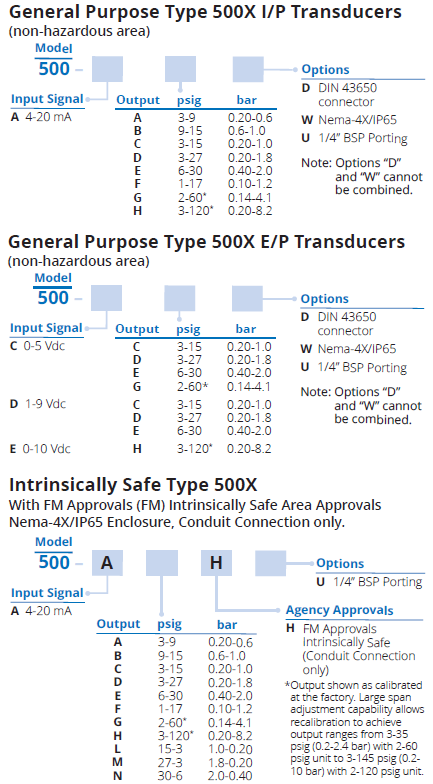
General-Purpose Type 500X I/P Ordering Structure
500 – A [Output] [Options]
I/P Input Signal
- A = 4-20 mA
I/P Output Ranges
- A = 3-9 psig (0.2-0.6 bar)
- B = 9-15 psig (0.6-1.0 bar)
- C = 3-15 psig (0.2-1.0 bar)
- D = 3-27 psig (0.2-1.8 bar)
- E = 6-30 psig (0.4-2.0 bar)
- F = 1-17 psig (0.1-1.2 bar)
- G = 2-60 psig (0.14-4.1 bar)
- H = 3-120 psig (0.2-8.2 bar)
General-Purpose Type 500X E/P Input Signals
- C = 0-5 VDC
- D = 1-9 VDC
- E = 0-10 VDC
Reverse-Acting I/P Output Ranges
- L = 15-3 psig (1.0-0.2 bar)
- M = 27-3 psig (1.8-0.2 bar)
- N = 30-6 psig (2.0-0.4 bar)
Available Options
- D = DIN 43650 Connector
- W = NEMA 4X/IP65 Enclosure
- U = 1/4″ BSP Pneumatic Porting
Important Configuration Note
- The DIN 43650 connector and NEMA 4X/IP65 enclosure options cannot be combined.
Intrinsically Safe Configuration
- Input: 4-20 mA
- H = FM Approved Intrinsically Safe
- NEMA 4X/IP65 enclosure standard
- Conduit electrical connection only
- U = Optional 1/4″ BSP pneumatic porting
Technical Resources
- Product Data Sheet
- Installation Instructions
- Product Configurator
- 3D CAD Models
- Certifications
- Engineering Support Resources
FAQs
What does the Type 500X electropneumatic transducer do?
The Type 500X converts a current or voltage input signal into a linearly proportional pneumatic output pressure.
What is the difference between an I/P and an E/P transducer?
An I/P transducer converts a current input, typically 4-20 mA, into pneumatic pressure. An E/P transducer converts a voltage input, such as 0-5 VDC or 0-10 VDC, into pneumatic pressure.
What input signals are available?
The Type 500X is available with 4-20 mA, 0-5 VDC, 1-9 VDC, and 0-10 VDC input signals, depending on the selected configuration.
What output pressure ranges are available?
Available factory-calibrated outputs include 3-9 psig, 9-15 psig, 3-15 psig, 3-27 psig, 6-30 psig, 1-17 psig, 2-60 psig, and 3-120 psig. Reverse-acting output ranges are also available for selected 4-20 mA models.
Can the Type 500X provide high-pressure pneumatic output?
Yes. High-output models are available with factory-calibrated ranges up to 3-120 psig and can be recalibrated within the adjustment limits described in the product data sheet.
Can the Type 500X be used outdoors?
Yes. The optional NEMA 4X/IP65 enclosure supports outdoor and splashdown installations. This enclosure is standard on the intrinsically safe version.
Is an intrinsically safe version available?
Yes. An FM Approved intrinsically safe 4-20 mA configuration is available with a NEMA 4X/IP65 enclosure and conduit electrical connection.
Can the Type 500X be configured for split ranging?
Yes. A 4-20 mA, 3-15 psig unit can be recalibrated to provide a 3-9 psig or 9-15 psig output.
What air quality is required?
The Type 500X requires oil-free, clean, dry air filtered to 40 microns.