Skip to content
Logo
×
Find a Distributor Request a Quote
  • Products
    • Pressure Regulators
    • Back Pressure Regulators
    • Filter Regulators
    • Gas Regulators
    • Precision Pressure Regulators
    • Pressure Regulators
    • Stainless Steel Pressure Regulators
    • Potable Water Pressure Regulators
    • Brackets, Gauges, & Accessories
    • Electronic Pressure Regulators
    • Pressure Transducers
    • I/P Transducers (current-to-pressure)
    • E/P Transducers (voltage-to-pressure)
    • P/I Transducers (pressure-to-current)
    • I/PAC Integrated Process Air Control
    • Supply Manifold
    • Brackets, Gauges, & Accessories
    • Diaphragm Air Cylinders
    • Rolling Diaphragm Cylinder
    • Small Bore Compact Cylinder
    • Mini Might Cylinders
    • Pneumatic Air Filters
    • Air Relays
    • Vacuum Regulators
    • Valve Positioners
    • Volume Boosters
    • Stainless Steel Volume Boosters
    • No-Brass Products
    • View All Products
  • Custom Solutions
  • Industries
    • Food and Beverage Processing Markets
    • Control Valve Products
    • Oil & Gas Markets
    • Waste Water Processing and Treatment
    • View All Industries
  • Engineers
  • Resources
    • Blog
    • CAD Models & Product Specifier
    • Certifications
    • Catalogs
    • FAQ
    • How to Determine the Appropriate Regulator
    • Instruction Manuals
    • Product Selection Guides
    • Visual Product Reference Guides
    • Videos
    • Volume Booster Sizing Guide
    • White Papers
  • Contact
    • Request a Quote
    • Ask an Expert
    • Contact
    • Request Help From Our Sales Team
  • About
    • About Us
    • News
    • Who We Help
    • Career Opportunities
  • Find a Distributor
  • Request a Quote
(603) 886-9400 | Distributor Login

What happens when an I/P transducer loses electrical signal?

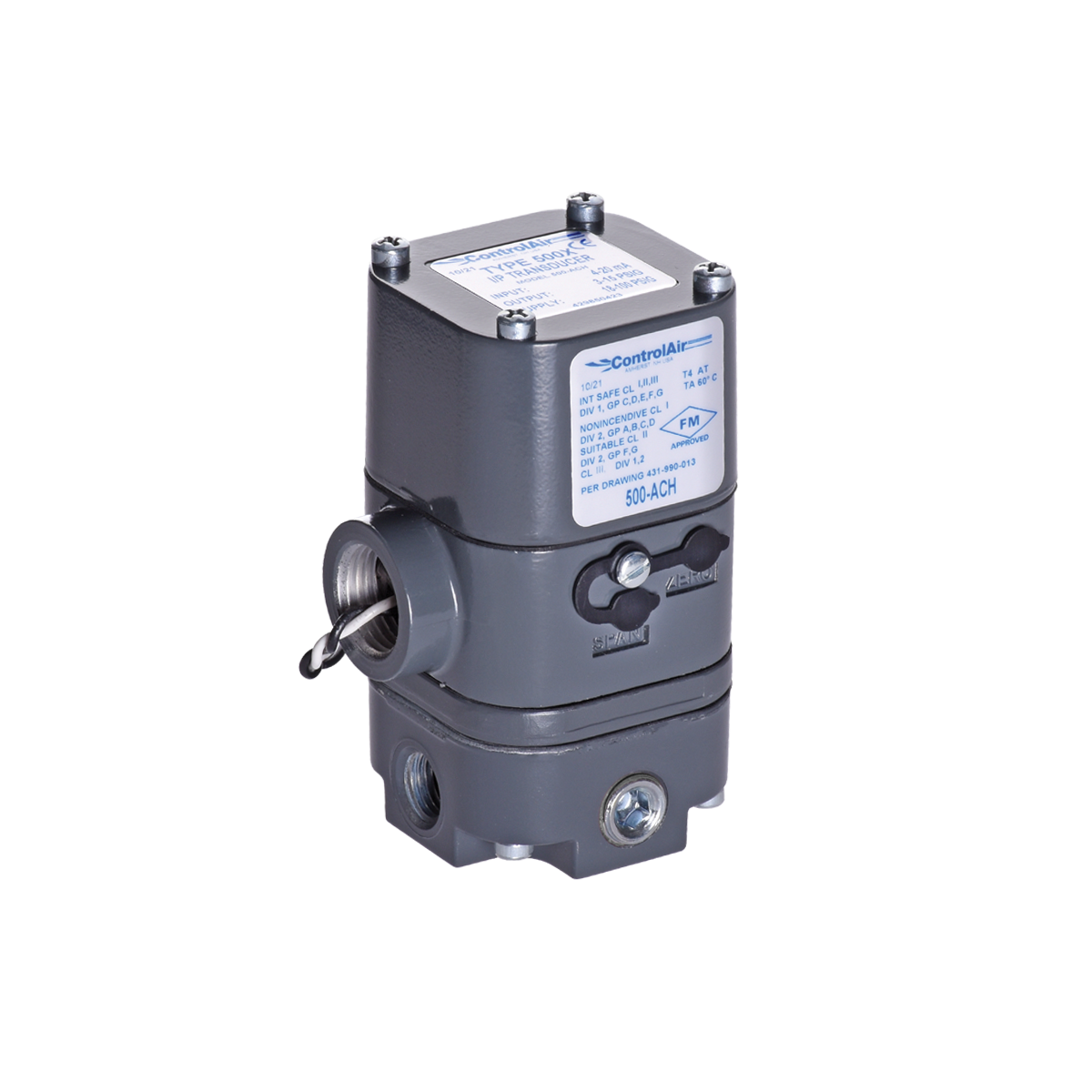
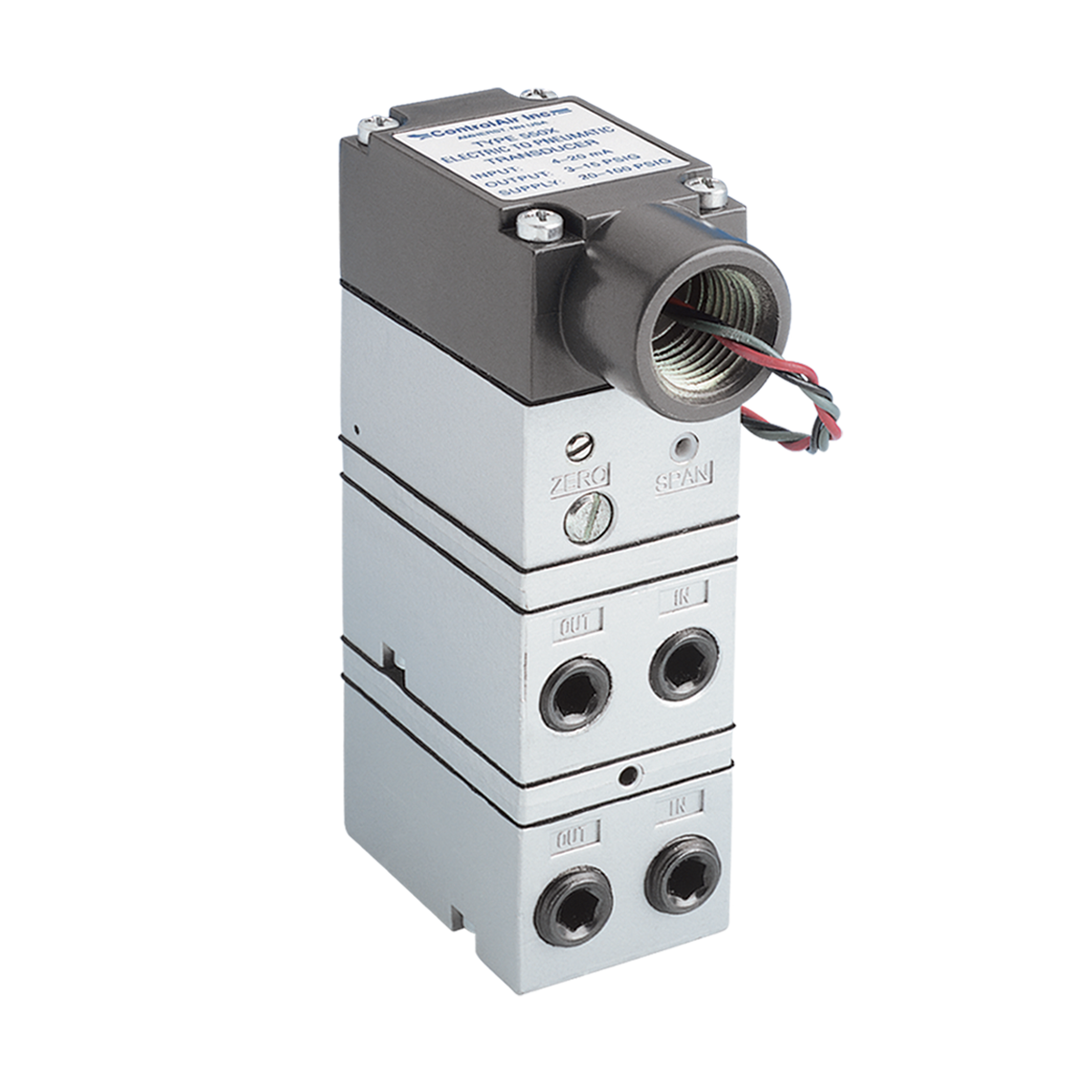
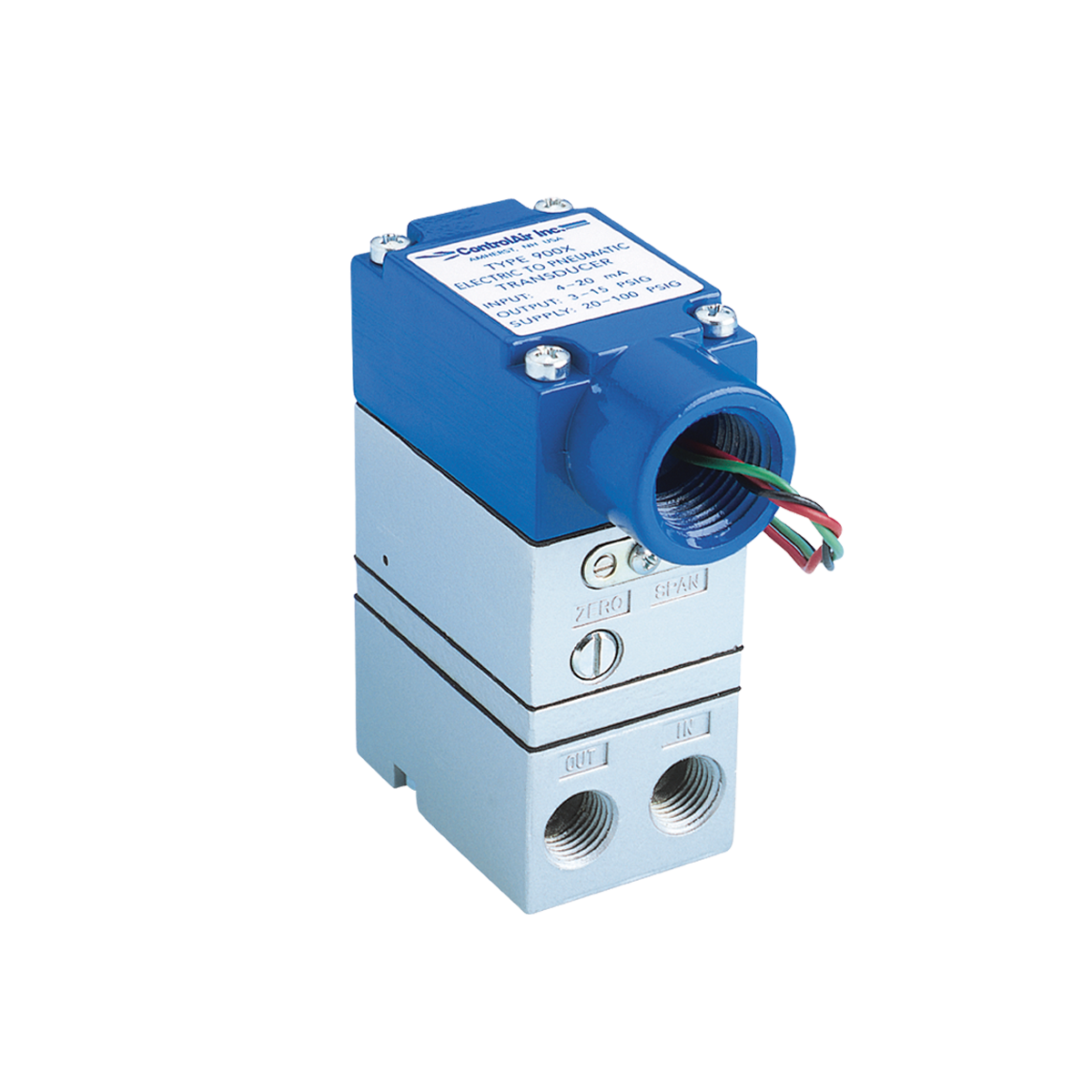
When an I/P transducer loses its electrical input signal, its output pressure depends on the model and pressure range. For the ControlAir configurations discussed here, non-zero-based Type 500, Type 550, and Type 900 units are expected to produce approximately 1.5 psi, while zero-based Type 550 and Type 900 units drop to 0 psi.

These conditions assume that the pneumatic air supply remains available. Losing the electrical signal and losing supply air are different operating conditions.

What Does an I/P Transducer Do?

An I/P, or current-to-pressure, transducer converts an electrical current signal into a proportional pneumatic output pressure. It connects electronic controls to pneumatic devices such as valve actuators and positioners.

A common configuration converts a 4–20 mA input into a 3–15 psig output. Other pressure ranges are available to suit different applications.

What Is the Output Pressure After Signal Loss?

The table below summarizes the expected behavior of the ControlAir configurations covered in this article.

ControlAir Model Non-Zero-Based Configuration Zero-Based Configuration
Type 500 Approximately 1.5 psi Not covered in this article
Type 550 Approximately 1.5 psi 0 psi
Type 900 Approximately 1.5 psi 0 psi

Verify the selected model and configuration when determining signal-loss behavior for an application.

Why Can an I/P Transducer Still Produce Pressure Without an Electrical Signal?

In the non-zero-based units described above, a start-up spring continues to apply force to the supply valve after the electrical input is lost. This allows some supply air to reach the output.

As a result, removing the electrical signal does not necessarily eliminate pneumatic output pressure.
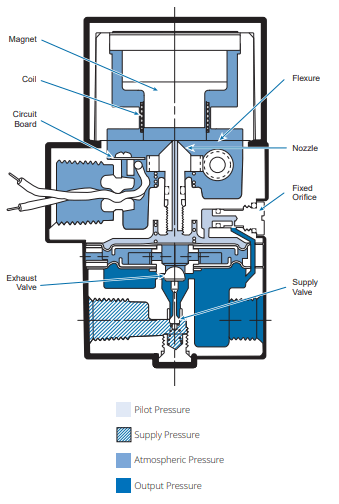
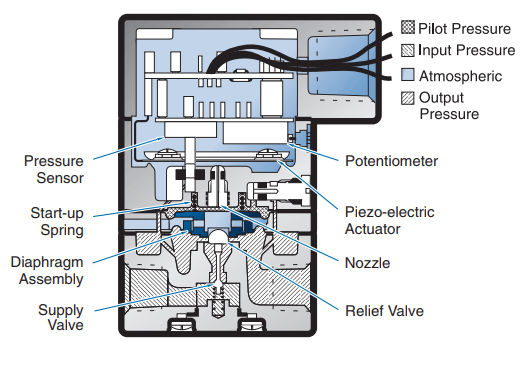
ControlAir Type 500 I/P transducer cutaway showing internal components
Type 500 I/P Transducer
Click image to enlarge in a new tab.

ControlAir Type 900 I/P transducer cutaway showing internal components
Type 900 I/P Transducer
Click image to enlarge in a new tab.

What Is a Zero-Based I/P Transducer?

A zero-based I/P transducer has an output range that begins at 0 psig. For example, ControlAir’s Type 550X is available with zero-based ranges of 0–30, 0–60, and 0–120 psig.

Zero-based designs use a negative-bias spring arrangement to provide a true zero-pressure output. The zero-based Type 550 and Type 900 configurations discussed here return to 0 psi when the electrical input is lost.

Is 4 mA the Same as Losing the Electrical Signal?

No. In a 4–20 mA control loop, 4 mA is a valid input representing the bottom of the calibrated range.

For a transducer configured for 4–20 mA input and 3–15 psig output:

  • 4 mA input: The commanded output is 3 psig.
  • 20 mA input: The commanded output is 15 psig.
  • Loss of input current: The output follows the transducer’s signal-loss behavior.

This distinction matters when evaluating a low output pressure or troubleshooting an interrupted control signal.

How Do You Select the Right I/P Transducer?

Start with the required electrical input and pneumatic output range. Then confirm the flow capacity, available supply pressure, mounting requirements, and expected output after signal loss.

Explore ControlAir’s Type 500, Type 550X, and Type 900X to compare configurations and access product specifications.

Post navigation

 New High Flow Precision Air Pressure RegulatorNew Precision Air Pressure Regulator for Applications That Require High Flow Capacity 

Ask an Expert

Contact our technical experts for help with your pneumatic application or ControlAir Product.

Question

First Name*

Last Name*

Email*

Company*

Country*

State/Province*

City*

How did you hear about us*

Click here if you want to be on our mailing list

I accept the terms of our Data Privacy Policy.

Data Privacy Policy

ControlAir’s purpose to collect any personal data is to respond to your request for product help, quotation and processing of orders. We take your privacy seriously. Here are some relevant questions and answers regarding our collection and use of personal data.

What information is being collected?

ControlAir will collect names, email addresses, phone numbers and local addresses so we may fulfill your request for product help, quotes or order shipment.

Who is collecting it?

ControlAir has a sales and marketing department that oversees the collection and use of this data. We do use a Customer Relationship Management system to process this information.

How is it collected?

Data is collected using our Webforms (Get a Quote, Ask the Expert, White Paper Sign Up, etc), via phone calls, incoming emails and during any email campaigns that are sent to you for marketing purposes.

Why is it being collected?

This information is being collected for the purpose to respond to your request and for later follow up to ensure that we provided you with a good customer experience. This information may be used to contact you in the future regarding ControlAir products.

How will it be used?

This information will be entered into a CRM database, so we can contact you via email, phone or mail to fulfill your request and follow up with appropriate product information.

Who will it be shared with?

Your information will not be sold to a third party. Your information maybe shared with one of our local partners (distributors and/or local field agent) so we can fulfill your request for product information and quotation.

What will be the effect of this on the individuals concerned?

The purpose of transferring this information to these individuals/companies will be to fulfill your request for product information and quotation. You may receive emails to alert you of order, quote or shipment status. You may also receive follow up emails to gauge your customer experience and alert you to product information.

Is the intended use likely to cause individuals to object or complain?

We do not expect individuals to object with the use of this data to fulfill an action that they requested of ControlAir. We will remove persons from any future emails if they choose to opt out of future emails.

Please let us know if you have any further questions regarding the processing and use of your information. We can be reached at 1-603-886-9400 or by email at [email protected]

Lead Source

Enter the Captcha*

captcha Reload
Call (800) 216-3636

Related Products

  • Type 500 Electro-Pneumatic I/P Transducer (I/P, E/P)

  • Type 550X I/P, E/P Transducer

  • Type 900X Miniature I/P, E/P Transducer

Sign up for the ControlAir newsletter.

Get news, updates, and offers direct to your inbox.

Industries We Serve
  • Food & Beverage
  • Oil & Gas
  • Control Valve
  • Water Treatment

Products

  • Pressure Regulators
  • Back Pressure Regulators
  • Filter Regulators
  • Precision Pressure Regulators
  • Pressure Regulators
  • Stainless Steel Pressure Regulators
  • Potable Water Pressure Regulators
  • Brackets, Gauges, & Accessories
  • Electronic Pressure Regulators
  • Pressure Transducers
  • I/P Transducers (current-to-pressure)
  • E/P Transducers (voltage-to-pressure)
  • P/I Transducers (pressure-to-current)
  • I/PAC Integrated Process Air Control
  • Supply Manifold
  • Brackets, Gauges, & Accessories
  • Diaphragm Air Cylinders
  • Rolling Diaphragm Cylinder
  • Small Bore Compact Cylinder
  • Mini Might Cylinders
  • Pneumatic Air Filters
  • Air Relays
  • Vacuum Regulators
  • Valve Positioners
  • Volume Boosters
  • Stainless Steel Volume Boosters
  • No-Brass Products
  • View All Products
Resources
  • Blog
  • CAD Models
  • Certifications
  • Catalogs
  • FAQ
  • How to Determine the Appropriate Regulator
  • Product Selection Guides
  • Whitepapers
  • Visual Product Reference Guide
  • Videos

ControlAir

International HQ
8 Columbia Dr
Amherst, NH 03031 USA

603-886-9400
1 (800) 216-3636
Send us a message


Privacy Policy | Site Map | © 2019 ControlAir. All rights reserved

We use cookies on our website to give you the most relevant experience by remembering your preferences and repeat visits. By clicking “Accept”, you consent to the use of ALL the cookies.
In case of sale of your personal information, you may opt out by using the link Do not sell my personal information.
Cookie settingsACCEPT
Manage consent

Privacy Overview

This website uses cookies to improve your experience while you navigate through the website. Out of these cookies, the cookies that are categorized as necessary are stored on your browser as they are essential for the working of basic functionalities of the website. We also use third-party cookies that help us analyze and understand how you use this website. These cookies will be stored in your browser only with your consent. You also have the option to opt-out of these cookies. But opting out of some of these cookies may have an effect on your browsing experience.
Necessary
Always Enabled
Necessary cookies are absolutely essential for the website to function properly. These cookies ensure basic functionalities and security features of the website, anonymously.
CookieDurationDescription
cookielawinfo-checkbox-analytics11 monthsThis cookie is set by GDPR Cookie Consent plugin. The cookie is used to store the user consent for the cookies in the category "Analytics".
cookielawinfo-checkbox-functional11 monthsThe cookie is set by GDPR cookie consent to record the user consent for the cookies in the category "Functional".
cookielawinfo-checkbox-necessary11 monthsThis cookie is set by GDPR Cookie Consent plugin. The cookies is used to store the user consent for the cookies in the category "Necessary".
cookielawinfo-checkbox-others11 monthsThis cookie is set by GDPR Cookie Consent plugin. The cookie is used to store the user consent for the cookies in the category "Other.
cookielawinfo-checkbox-performance11 monthsThis cookie is set by GDPR Cookie Consent plugin. The cookie is used to store the user consent for the cookies in the category "Performance".
viewed_cookie_policy11 monthsThe cookie is set by the GDPR Cookie Consent plugin and is used to store whether or not user has consented to the use of cookies. It does not store any personal data.
Functional
Functional cookies help to perform certain functionalities like sharing the content of the website on social media platforms, collect feedbacks, and other third-party features.
Performance
Performance cookies are used to understand and analyze the key performance indexes of the website which helps in delivering a better user experience for the visitors.
Analytics
Analytical cookies are used to understand how visitors interact with the website. These cookies help provide information on metrics the number of visitors, bounce rate, traffic source, etc.
Advertisement
Advertisement cookies are used to provide visitors with relevant ads and marketing campaigns. These cookies track visitors across websites and collect information to provide customized ads.
Others
Other uncategorized cookies are those that are being analyzed and have not been classified into a category as yet.
Save & Accept